

Have a medical question?
- Learn about your treatment options
- Ask questions about your diagnosis
- Get doctor recommendations


Written By: David Statman
Surgical management of malignant peritoneal mesothelioma is achieved through cytoreductive surgery and hyperthermic intraperitoneal chemotherapy (HIPEC). The procedure, often called HIPEC surgery, removes tumors and kills cancer cells in the abdominal cavity through cytoreduction (debulking) and intraperitoneal chemotherapy.

Precision Oncology Scientist
Dr. Stephen Williams is a Precision Oncology Scientist in the Department of Pathology and Laboratory Medicine at MD Anderson Cancer Center in Houston, Texas. Dr. Williams served as a medical reviewer, guest blog writer, and medical content writer for Mesothelioma Guide since 2024. He helped the organization inform and educate patients and loved ones about cancer treatment – ensuring all content published on the Mesothelioma Guide website was accurate, concise, and clear. Learn more about Dr. Stephen Williams
This page provides an overview of mesothelioma cytoreduction with HIPEC, a specialized surgical treatment option designed for certain cases of abdominal mesothelioma. The treatment combines two procedures: cytoreductive surgery, to remove visible tumors and affected tissues from the abdominal cavity, and hyperthermic intraperitoneal chemotherapy (HIPEC), a heated chemotherapy treatment directly applied inside the abdomen. This approach aims to decrease the cancer burden significantly, targeting both visible and microscopic cancer cells, with the goal of improving patient outcomes. The combined procedure is thorough and complex, often lasting up to 14 hours, but it has shown promising survival rates and the potential to extend life for eligible patients.
The development of this treatment was largely driven by pioneering surgeons such as Dr. Paul Sugarbaker, who introduced techniques like peritonectomy and the use of heated chemotherapy to improve effectiveness. Cytoreductive surgery focuses on removing as much tumor tissue as possible, which may involve excising parts of affected organs or the lining of the abdomen, called the peritoneum. Following surgical removal, HIPEC involves circulating heated chemotherapy drugs, often at around 107 degrees Fahrenheit, within the abdominal cavity to effectively kill residual cancer cells. This targeted treatment maximizes cancer cell destruction while minimizing systemic side effects commonly associated with traditional chemotherapy.
Patients considering this treatment typically undergo a thorough evaluation to determine eligibility, which depends on factors like the extent of disease, overall health, and specific tumor characteristics. Recovery times vary, but patients generally spend 10 to 14 days in the hospital immediately following surgery, with ongoing outpatient care or rehabilitation extending several weeks or months. While this is a demanding procedure, many patients experience symptom relief and a possible extension of life, especially when performed at experienced cancer centers by specialized surgical teams. Understanding the goals, process, and potential outcomes of cytoreduction with HIPEC can help patients and families make informed decisions about this advanced treatment option for mesothelioma involving the abdominal cavity.
To learn more about cytoreductive surgery with HIPEC for your peritoneal mesothelioma, our patient advocates are available to help. They can guide you through the necessary steps to find highly-rated medical care and top mesothelioma specialists:

Following your official diagnosis of peritoneal mesothelioma, contact a cancer center and find a mesothelioma specialist. We can help you find a cancer center close to where you live.

Learn the details about cytoreductive surgery with hyperthermic intraperitoneal chemotherapy for peritoneal mesothelioma, including survival rates, side effects, recovery time and what to expect.

Contact a peritoneal mesothelioma surgeon to schedule a consultation. This is the most important step, as you don’t want an inexperienced doctor performing your surgery. Let us help you find the best surgeon for your specific needs.
Cytoreductive surgery plus HIPEC is a comprehensive and specialized medical procedure designed to treat certain cancers within the abdominal cavity. Cytoreductive surgery (CRS) involves the meticulous removal of visible tumors and affected tissue, aiming to reduce the cancer burden to microscopic levels.
This is followed by hyperthermic intraperitoneal chemotherapy (HIPEC), a mesothelioma treatment where heated chemotherapy drugs are circulated within the abdominal cavity to eliminate residual cancer cells. The combination maximizes therapeutic impact by addressing both the visible and microscopic disease, offering improved outcomes for conditions like peritoneal mesothelioma while minimizing systemic toxicity.
Some patients receive a less aggressive and invasive cytoreduction/HIPEC for palliative purposes, which can extend survival by a few months and decrease discomfort from symptoms, such as abdominal fluid build-up (ascites) or tumors pressing against certain organs.

At the Medical College of Wisconsin, 17 cancer patients underwent 20 HIPEC surgeries for palliative reasons. While the average survival was less than one year, symptom management improved and reduced patient symptoms 90% of the time. Symptom relief was reduced or permanently resolved after HIPEC surgery for an average of 5.1 months.
Cytoreductive surgery with HIPEC is also referred to as CRS plus HIPEC or cytoreduction with HIPEC. It was developed at the end of the 20th century, thanks in large part to mesothelioma specialist Dr. Paul Sugarbaker of the Washington Cancer Institute. Dr. Sugarbaker’s influence on the development of this surgery is why it’s often called the “Sugarbaker Technique.”
Cytoreduction surgeries have existed since the middle of the 20th century. Dr. Joe Meigs at Massachusetts General Hospital in Boston first reported using tumor debulking surgery for the treatment of ovarian cancer in 1934. However, the procedure did not become widely used until the 1970s. Doctors began introducing intraoperative chemotherapy for abdominal cancer treatment in the 1970s and 1980s.
In 1995, Dr. Sugarbaker introduced the surgical procedure called peritonectomy to the cytoreduction portion. Peritonectomy is a precise technique to remove sections or the entire peritoneal (abdominal) lining to address cancers or diseases that involve the abdominal cavity.

Cytoreductive surgery is a highly specialized procedure aimed at manually removing visible tumors from the abdominal cavity, making it the only radical surgical option for patients with peritoneal mesothelioma. The primary goal of this “debulking” surgery is to eliminate all visible tumors and diseased tissue within the abdomen, although microscopic cancer cells may still remain.
During the mesothelioma surgery, surgeons often remove the omentum, which is a layer of fatty tissue covering the abdominal organs. Doctors also remove the entire peritoneum, which is the membrane lining the abdominal cavity.
Depending on the extent of the disease, other organs may need to be partially or completely removed if tumors are inseparable from the organ’s surface and removal poses no significant health risks. Organs that can be safely removed include the gallbladder, spleen, and sections of the small or large intestine, ensuring comprehensive tumor reduction while prioritizing patient safety.
An article published in JAMA stated surgeons may remove the pancreas, kidney, ureter, bladder and uterus without increasing severe complications or mortality rate.

HIPEC, or hyperthermic intraperitoneal chemotherapy, is a cutting-edge intraoperative treatment designed to target and kill peritoneal mesothelioma cancer cells.
Often referred to as “hot chemotherapy,” this technique has significantly improved outcomes for patients with this rare and aggressive disease. HIPEC involves delivering chemotherapy drugs directly into the abdominal cavity, reducing many of the side effects commonly seen with systemic (intravenous) chemotherapy.
During the procedure, doctors prepare a heated chemotherapy solution, often using drugs like cisplatin or carboplatin, with additional options including doxorubicin or mitomycin, depending on the case. The solution is heated to a precise temperature to enhance its cancer-fighting properties and circulated throughout the abdominal cavity for about 60-90 minutes.
Following the infusion, the chemotherapy drugs are drained, and the abdominal cavity is flushed with a sterile saline solution to remove any remaining chemotherapy agents. Despite its complexity, HIPEC is a vital component of treatment for patients with peritoneal mesothelioma, offering a targeted and effective approach to managing the disease.

The peritoneum is a layer of mesothelial tissue that lines the entire abdominal cavity and covers the abdominal organs. Composed of fluid and mesothelial cells, it serves as a protective barrier for the organs within the abdomen and aids in maintaining their proper function.
The peritoneum has two distinct tissue layers: the parietal peritoneum, which lines the walls of the abdomen and pelvis, and the visceral peritoneum, which wraps around the abdominal organs. Between these two layers lies the peritoneal cavity, a space filled with a lubricating fluid that reduces friction and allows the tissue linings to glide smoothly against each other. This fluid also allows the abdominal organs to move freely within the cavity, facilitating their proper function.
When tumors develop in either tissue layer of the peritoneum, this is called peritoneal mesothelioma. The tumors can disrupt the normal functioning of the abdominal cavity. As the tumor grows, they occupy space within the cavity, leading to symptoms such as abdominal pain, bloating, and loss of appetite.
Systemic (intravenous) chemotherapy (typically pemetrexed and either cisplatin or carboplatin) for peritoneal mesothelioma is the primary treatment option. Systemic chemotherapy is often a combined treatment with cytoreductive surgery and HIPEC. Doctors can use mesothelioma chemotherapy either before or after cytoreductive surgery.
Doctors may use an alternative type of intraperitoneal chemotherapy treatment for malignant peritoneal mesothelioma. Dwell chemotherapy is a method of delivering chemotherapy drugs directly into a specific area of the body, often through a catheter or other delivery system, to treat localized cancers.
This local delivery increases drug concentration at the tumor site while reducing systemic toxicity. Doctors can then deliver chemotherapy drugs into the abdominal cavity multiple times in the weeks following surgery. While this method produces higher local drug concentration and lower systemic side effects, the placement of a catheter or port carries risk of infection and/or complications.
Cytoreductive surgery and intraperitoneal hyperthermic chemotherapy is a long, complex surgery. Prior to incision, the patient is given anesthesia and closely monitored throughout the surgical procedures. The patient is properly positioned for surgery to ensure a safe surgical experience.
CRS and HIPEC for malignant peritoneal mesothelioma can take up to 14 hours. The extent of the cancer determines how long the surgery takes.
The Process of Cytoreduction with HIPEC
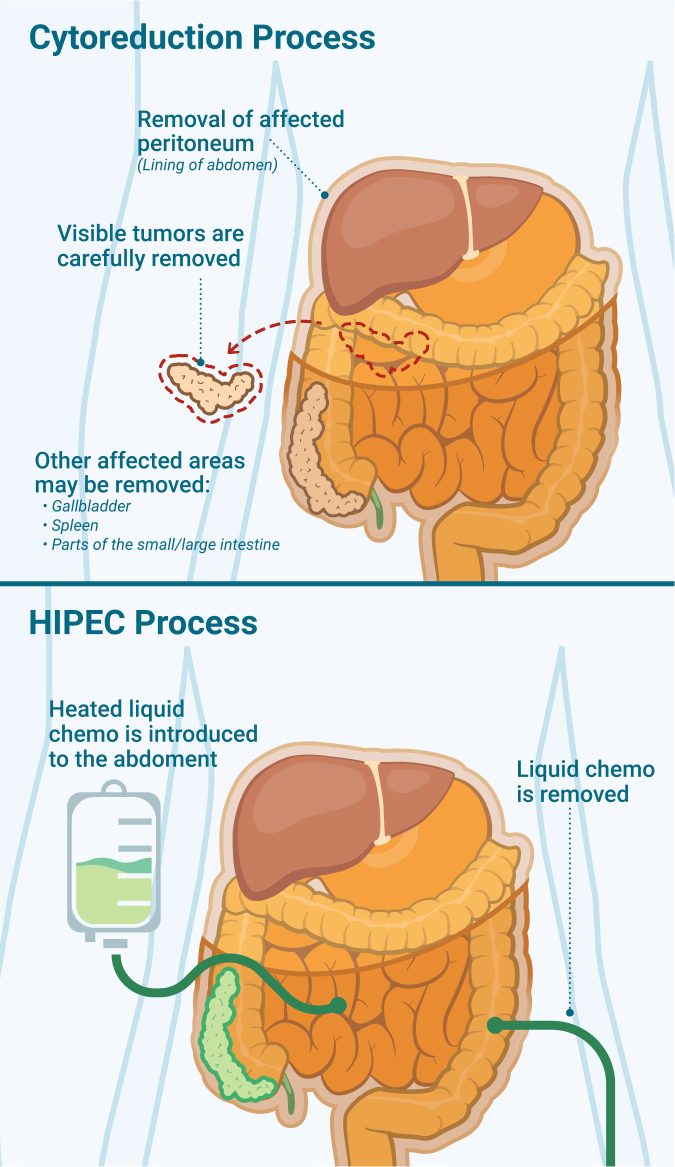
Here are the steps of cytoreductive surgery with HIPEC:
The surgeon creates a laparotomy incision from just below the xiphoid (small bone just below the sternum) down the middle of the abdomen. The surgeon examines the peritoneal surfaces and organs to confirm the extent of the disease.
The surgeon removes as many visible tumors as possible in the abdominal cavity. Surgeons also remove the omentum, which is fatty tissue covering the surface of the organs in the abdomen.
This is the removal of part or all of the peritoneum lining the abdominal cavity, which is where peritoneal mesothelioma forms. This procedure is only performed at special cancer centers.
If necessary and safe, the surgeon removes any diseased tissue and organs. They may also remove part or all of the diaphragm (respiratory muscle).
The surgical team inserts catheters/ports into the patient’s abdomen. These catheters deliver and drain the chemotherapy solution from the abdominal cavity.
Closing the incision during HIPEC is called the closed-abdominal technique. Reconstruction could happen after HIPEC, which is called the open-abdominal technique.
The surgical team heats chemotherapy to around 107 degrees Fahrenheit and delivers it into the abdominal cavity through a catheter. The chemotherapy is circulated through the abdominal cavity for ~60–90 minutes.
The chemotherapy is drained from the body and then the abdominal cavity is flushed with sterile saline. Doctors will then remove the catheters/ports and close any remaining open incisions.

If the patient is scheduled to receive dwell chemotherapy as an adjuvant (post-surgical) treatment, doctors will leave the catheters in the abdomen at the end of the surgery. These catheters will provide direct access into the abdominal cavity and offer a path to administer additional chemotherapy treatments to that area.
There are two main techniques for HIPEC:
The choice between closed-abdominal HIPEC and open-abdominal HIPEC depends on several factors:
Both methods are effective, and outcomes largely depend on achieving complete cytoreduction and ensuring uniform exposure of peritoneal surfaces to the heated chemotherapy.
According to the surgeons at Johns Hopkins Medicine in Baltimore, MD, complete cytoreductive surgery with HIPEC requires approximately 2-3 months of recovery. Patients should expect to spend 10-14 days in the hospital following surgery. Additional recovery continues for 6-10 weeks after discharge from the hospital.

Following surgery, most patients go to the intensive care unit (ICU). They will be monitored carefully and receive IV fluids and pain medication to help with recovery. Patients may experience bowel issues due to the length of the surgery.
The postoperative team will monitor bowel function, fluid and food intake, as well as progress with mobility (getting up to a chair and walking). This helps determine when a patient can transition from inpatient recovery to outpatient recovery.

Outpatient recovery can happen either at the patient’s home, the home of a loved one, or a medical rehabilitation facility. The outpatient recovery time varies.
Patients may remain on IV fluid treatments to ensure they receive nutrition. This also helps the digestive system recover.
Patients who undergo CRS and HIPEC will have regular follow-up appointments with the surgical specialist and oncologist. These check-ins are to monitor imaging scans for success of the surgery signs of recurrence. The patient will often have their first follow-up within a couple of weeks after hospital discharge. They will continue every few months initially, then transition to every six months and eventually advance to annual check-ins.
Patient eligibility for cytoreduction followed by hyperthermic intraperitoneal chemotherapy depends on a few factors. The first is the PCI score, as this score summarizes the extent of the tumors present in the abdomen, how far the tumors have spread and if the tumors have infiltrated to the abdominal organs.
Other factors affecting who can have this surgery are:

Physical health

Age

Cell type

A patient’s PCI score is a significant factor in determining if a patient is a candidate for cytoreductive surgery. PCI is a numerical scoring system used to quantify the tumor burden in the peritoneal cavity. This score is an important measuring tool used to evaluate how far the tumors have spread in the abdominal cavity. If the cancer is too advanced, surgery won’t remove enough of the disease to improve the patient’s life expectancy.

Peritoneal mesothelioma specialists have different opinions on what PCI score is too high to operate. Dr. Shanel Bhagwandin, from Jupiter Medical Center, said scores higher than 20 often don’t qualify for surgery.
“In terms of the research out there and advances that we’ve made looking at patients who benefit from this procedure, traditionally, if you have a score that’s higher than 20, usually the patient won’t respond well to surgery,” he said. “It usually means they have more disease than can be affected by surgery without all the associated risks.”
Dr. Shanel Bhagwandin
Peritoneal Mesothelioma Specialist

Physical health is an important factor in eligibility for invasive surgery. Since cytoreduction with HIPEC involves an open abdominal surgery, removal of tissue and organs, and the use of heated chemotherapy, patients must be strong enough to withstand anesthesia, postoperative recovery and postoperative pain.
If the patient has a concerning medical history or lingering health issues, surgeons may avoid aggressive treatment. Operating on patients in poor health can cause severe complications.

Cytoreductive surgery and perioperative intraperitoneal chemotherapy is an aggressive treatment for peritoneal mesothelioma. This procedure would be difficult for most patients, but especially challenging for older patients. Younger patients with this rare cancer are more likely to be in better overall health and able to tolerate the procedure and recover from this surgery.
Alexis Kidd, a peritoneal mesothelioma survivor of more than 13 years, received cytoreductive surgery with HIPEC in her late thirties. The average age for peritoneal mesothelioma patients is between 50 and 60.
“Because I was younger and healthier, they were able to be aggressive when treating me.”
Alexis Kidd
Peritoneal Mesothelioma Survivor
Older patients — those in their sixties, seventies or eighties — may still qualify for the HIPEC procedure, but the selection process would need to determine if cytoreduction plus HIPEC was possible. It is important to discuss all treatment options with a mesothelioma specialist.

Mesothelioma cell type is another important aspect in determining eligibility for surgery. Epithelioid mesothelioma cells are easier to treat, due to being the easiest to identify and remove. Sarcomatoid cells grow and spread faster than other cell types, which makes it more difficult to identify and treat.
Some surgeons may choose to be more aggressive and only accept patients with the epithelioid cell type. Sarcomatoid and biphasic mesothelioma types are still considered for surgery but present a more challenging surgical candidate. Specialists may choose other treatment alternatives in the management of their disease.

Epithelioid cells account for 75% of peritoneal mesothelioma cases. This is good news for patients seeking to be treated with CRS plus HIPEC.
Fortunately, there has been a steep improvement in the life expectancy for people with peritoneal mesothelioma, which is attributed to the development and advancement of cytoreductive surgery and HIPEC treatment.
The National Cancer Database includes 700 cases of peritoneal mesothelioma treated with cytoreduction and HIPEC. The average survival was 38 months (3 years, 2 months). If patients did not receive surgery, their survival was 7.1 months on average.

Wake Forest Baptist Cancer Center reported a median survival of 40 months (3 years, 4 months). The five-year survival rate was around 30%. Other centers report five-year survival rates of around 50%.

Medical experts suggest cancer patients begin treatment right after diagnosis. The longer patients wait, the more likely the cancer will spread and become untreatable with surgery or immunotherapy.
Many studies support this theory, showing how patients getting treatment immediately will improve their survival and life expectancy. For peritoneal mesothelioma patients, the main option is HIPEC surgery and there’s scientific data supporting surgery as soon as possible.
The Journal of Gastrointestinal Surgery published a report comparing the wait times for peritoneal mesothelioma patients — and the effect on survival. When patients get HIPEC/cytoreductive surgery within four weeks of their diagnosis, their life expectancy is more than 5 years.
The longer the wait time for surgery, the worse the life expectancy:
Delayed surgery (4-12 weeks after diagnosis) — 4.8 years of life expectancy
Delayed surgery (13-24 weeks after diagnosis) — 4.37 years of life expectancy
No surgery — 2.1 years of life expectancy

Adding systemic chemotherapy after cytoreduction and HIPEC can improve the life expectancy for malignant mesothelioma of the peritoneum. This is a common multimodal treatment used with the HIPEC procedure.
Giving chemotherapy for diffuse malignant peritoneal mesothelioma before surgery is called “adjuvant chemotherapy.” The National Cancer Database research showed a median survival of 41.2 months (3 years, 5 months) when chemotherapy was used after surgery. Another is immunotherapy through clinical trials, this treatment is currently the only FDA-approved treatment for pleural mesothelioma.
Dwell chemotherapy is another intraperitoneal chemotherapy for malignant peritoneal mesothelioma. The ports used with HIPEC during surgery are left in the abdomen when surgery ends. This allows doctors to deliver liquid chemotherapy directly into the abdominal cavity multiple times in the weeks following surgery. For peritoneal mesothelioma, the dwell chemotherapy used is “NIPEC” (normothermic intraperitoneal chemotherapy).

Dr. Paul Sugarbaker reported a 75% 5-year survival rate for select patients undergoing cytoreduction, HIPEC and NIPEC. This protocol also included “EPIC” (early postoperative intraperitoneal chemotherapy), which is the first session of dwell chemotherapy. Paclitaxel is one chemotherapy drug option for NIPEC.
Alexis Kidd received NIPEC following her cytoreductive surgery with HIPEC. She’s one of the longest survivors of peritoneal mesothelioma, largely thanks to cytoreductive surgery with HIPEC and NIPEC.
“I remember they left two ports in my lower abdomen after surgery. That’s how we did the chemo after,” she said. “They put cisplatin in one port and laid me on my side. Then they switched sides to lay me on the other side.”
Alexis Kidd
Peritoneal Mesothelioma Survivor
Patients may experience complications from cytoreductive surgery and HIPEC. Many are related to the digestive tract:
Risk factors for complications during or after cytoreduction/HIPEC surgery include:


A report in the Journal of Gastrointestinal Oncology assessed that most mesothelioma patients will have recurrence after HIPEC surgery. It occurs within the abdominal cavity in up to 57% of patients.
Recurrence can occur locally within the peritoneal cavity or systemically, depending on factors such as the initial tumor burden (PCI score), completeness of cytoreduction, and tumor biology. Patients with recurrent disease may be considered for additional treatments, including repeat CRS with HIPEC, systemic chemotherapy, or palliative care, depending on their overall health and the extent of the recurrence. Regular monitoring with imaging and tumor markers is essential to detect and manage recurrence early.
A second surgery can improve the already elevated survival times for this operation:

Researchers from the University of Nebraska-Omaha Cancer Center reported a 30-day mortality rate of 1.1% for cytoreduction with HIPEC. This was much lower than the mortality rates for these other major surgeries:
Quality of life is a significant concern for patients considering peritoneal mesothelioma surgery. Increased discomfort and additional health concerns are always possible following any major operation.
Researchers at Wake Forest Baptist Cancer Center reported improvement in quality of life following the HIPEC procedure. Their physical functioning initially worsened but then reached preoperative normalcy at the one-year mark.
Other findings were:
There is a long list of doctors who perform cytoreductive surgery followed by HIPEC. There are surgeons in each region of the country who specialize in peritoneal mesothelioma. They work at the top cancer centers in the world, with vast resources at their disposal.
Some of the top mesothelioma surgeons who perform cytoreductive surgery and HIPEC:

Baylor St. Luke’s Health Medical & Houston VA Medical Center
(Houston, TX)


University of California-San Diego Moores Cancer Center
(San Diego, CA)

University of Miami Sylvester Comprehensive Cancer Center
(Miami, FL)

Vanderbilt University-Ingram Cancer Center
(Nashville, TN)
The VA healthcare system provides veterans access to the top cancer doctors in the world. Three VA hospitals have mesothelioma treatment programs, staffed by experienced surgeons and oncologists from nearby cancer centers.
The Houston VA program is the only one known to treat peritoneal mesothelioma. Dr. Eugene Choi is the head peritoneal mesothelioma surgeon at the Houston VA Medical Center.

If you need help with your VA benefits and finding a VA hospital, please reach out to LCDR Carl Jewett. As a VA-accredited claims agent and patient advocate, he can help you find the specialized treatment strategies you need.

Cytoreduction with HIPEC is a combination of resection surgery and heated chemotherapy used as a treatment of peritoneal mesothelioma. Cytoreduction for mesothelioma involves removing the peritoneum (the thin lining of the abdominal cavity) and manually removing all visible tumors. HIPEC stands for hyperthermic (heated) intraperitoneal chemotherapy. It involves bathing the abdominal cavity with liquid chemotherapy.
One study shows that patients treated with cytoreductive surgery have a 5-year survival rate of 80%. By comparison, peritoneal mesothelioma patients without surgery have an average one-year survival rate of 50%. Complete cytoreduction with HIPEC is an effective treatment with an extraordinary success rate for extending the lives of malignant peritoneal mesothelioma patients.
All surgeries have risks, the severity ranging from minor infections or side effects to internal bleeding. Cytoreduction is no different, but safety has improved in recent years. Potential complications related to this mesothelioma treatment include damage to the organs in the abdominal cavity or to the digestive system. In one study, 22% of patients undergoing cytoreductive surgery experienced surgery-related side effects.
Recovery time from cytoreductive surgery with HIPEC is approximately 6-8 weeks. Most patients spend 1-2 weeks in the hospital following their surgery. Outpatient recovery — at their home or temporary residence — takes 4-6 weeks depending on how the patient responds to the operation. Patients return to a more normal routine 3-6 months after surgery.
The duration of cytoreduction surgery and HIPEC can last up to 14 hours. The cytoreduction part is a meticulous process where surgeons attempt to detect and remove all visible tumors. The extent of the disease determines how long cytoreduction takes. HIPEC is administered and circulated in the abdominal cavity for a period of 60-90 minutes — it is then drained and the abdomen flushed with saline.
According to a report in the Annals of Surgical Oncology, the median cost of cytoreduction with HIPEC was $20,509. A New York Times article says the cost ranges from $20,000 to $100,000. Health insurance usually covers some or all of the expenses after the deductible.