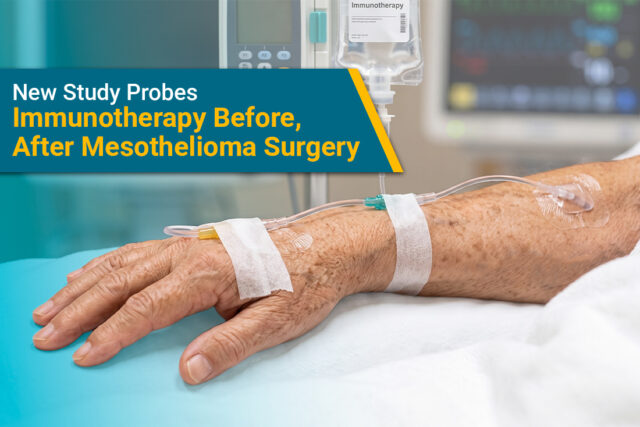
A new study led by a team of Italian researchers is probing a new approach in treating resectable pleural mesothelioma, a form of the rare and deadly cancer that has proved a difficult nut to crack for cancer researchers for a number of years.
The phase 2 CHIMERA trial is attempting to make a breakthrough in the effectiveness of chemotherapy both before and after surgery for resectable pleural mesothelioma, which for over a decade has shown a rate of pathological complete response to induction chemotherapy at just 5%.
To do this, the multicenter study sponsored by the Veneto Institute of Oncology is experimenting with adding an immune checkpoint inhibitor – pembrolizumab, also known by the brand name Keytruda – alongside a chemotherapy regimen both before and after surgery. The research team hopes this can more than triple the complete response rate to chemotherapy.
The first patient received treatment in November 2024, an enrollment was expected to be completed in June.
How Does the CHIMERA Study Target Mesothelioma?
Pleural mesothelioma is the most common form of the rare cancer mesothelioma, which is caused by exposure to the naturally occurring mineral asbestos. Pleural mesothelioma is named because it forms in the lining of the lungs, or the pleura – when a patient’s tumors are able to be surgically removed, their cancer is called resectable.
There are two types of surgery that can target pleural mesothelioma: extrapleural pneumonectomy (EPP), or the removal of the entire affected lung and surrounding affected tissues, and pleurectomy with decortication (P/D), a less aggressive procedure that removes the pleura and other diseased tissue, leaving the lung intact. No matter the surgical option, patients usually receive a chemotherapy regimen before and after the procedure.
The CHIMERA study is intended to significantly strengthen the efficacy of these chemotherapy regimens before and after surgery. The 40 or so patients enrolled in the study will receive pembrolizumab alongside the typical chemotherapy regimen of pemetrexed and cisplatin or carboplatin for three cycles before surgery, then 14 cycles of pembrolizumab after surgery.
The researchers hope that adding pembrolizumab to the equation will boost overall survival, an idea they have taken from other recent mesothelioma studies. The CHIMERA team specifically cited the CheckMate-743 and KEYNOTE-483 trials as showing that adding immunotherapy significantly increased survival and response rates as opposed to chemotherapy alone.
However, this dynamic has not been fully studied around mesothelioma surgery, something that the CHIMERA study looks to address.
What Could the CHIMERA Study Mean for Mesothelioma Treatment?
Again, while chemotherapy is commonly used before and after mesothelioma surgery, the rate of complete response – meaning that no residual tumor can be found after treatment – has sat at a mere 5% for over a decade.
The CHIMERA study aims to increase this rate to a targeted 18%, a number its researchers arrived at by looking at data from earlier immunotherapy trials in mesothelioma and in non-small cell lung cancer. They also intend to generate important data on the feasibility of the treatment and overall survival, and information on biomarkers.
Building on other important steps made by immunotherapy studies for mesothelioma, the CHIMERA study looks to clarify the potential role of immunotherapy in and around mesothelioma surgery, and results are on the horizon.
Sources & Author
- CHIMERA: A Phase II Study of Neoadjuvant Pembrolizumab in Combination With Cisplatin or Carboplatin and Pemetrexed Followed by Surgery and Adjuvant Pembrolizumab in Resectable Pleural Mesothelioma. Clinical Lung Cancer. Retrieved from https://www.sciencedirect.com/science/article/pii/S1525730426000720. Accessed on 07/31/2026.