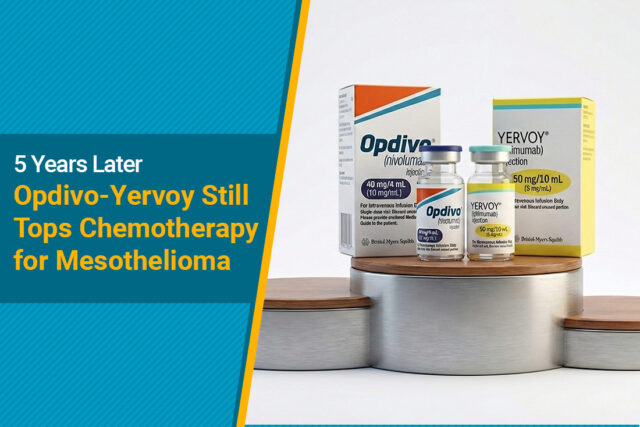
Checkmate-743 was a historic study in the treatment of mesothelioma, a fast-spreading cancer that gives patients poor life expectancies. It forever changes the trajectory of how doctors treat this rare type of cancer, officially putting immunotherapy on par with the long-standing cancer treatment known as chemotherapy.
Five years after Checkmate-743 was published, a follow-up evaluation confirms what the original report said: Immunotherapy is usually more effective than chemotherapy at slowing down mesothelioma.
5-Year Survival Rate: More Than Double for Opdivo-Yervoy
A 5-year follow-up published in the Journal of Clinical Oncology, compared the 5-year survival rates of immunotherapy and chemotherapy on people with unresectable pleural mesothelioma, a type of mesothelioma forming in the lining of the lungs. For pleural mesothelioma, when surgery is not an option for patients, the next best for years has been chemotherapy.
The study tested the use of immune checkpoint inhibitors, specifically Opdivo (nivolumab) and Yervoy (ipilimumab). The study included 605 patients with unresectable pleural mesothelioma. Half received Opdivo and Yervoy, and the other half received chemotherapy.
Initial data supported the use of Opdivo and Yervoy:
- 18.1 months median survival for people who received Opdivo and Yervoy
- 14.1 months median survival for people who received chemotherapy
After 5 years, the more effective treatment hasn’t changed. Opdivo and Yervoy led to a 5-year survival rate of 14%. This means 14% of the people who received immunotherapy for mesothelioma in the study lived for at least 5 years – and maybe more.
By comparison, chemotherapy led to a 5-year survival rate of just 6%. The average 5-year survival rate for this cancer – considering all cases – has been approximately 7%-8%.
Opdivo and Yervoy outperformed chemotherapy at every interval of the study.:
- The 1-year survival rates were 68% for Opdivo and Yervoy and 58% for chemotherapy.
- The 2-year survival rates were 41% and 27%, respectively.
- The 3-year survival rates were 23% and 15%, respectively.
- The 4-year survival rates were 17% and 11%, respectively.
Most Patients in Study in ‘Late-Stage Mesothelioma’
Most of the patients in Checkmate-743 had what’s considered a “late-stage” diagnosis of mesothelioma. They were in either stage 3 or stage 4, which is when mesothelioma is toughest to treat. Surgery is rarely an option, and most patients have relied on chemotherapy to extend their lives by precious few months.
Opdivo and Yervoy performing this well is a sign that even late-stage patients may be able to live for multiple years on an immunotherapy treatment plan.
Opdivo and Yervoy Shines Against Sarcomatoid Cell Type
Opdivo and Yervoy also helped patients who had a more hostile type of mesothelioma. Sarcomatoid mesothelioma is a cell type considered especially tough to treat. Sarcomatoid cells are tougher to locate and spread more aggressively.
By comparison, epithelioid mesothelioma cells are a little tamer and easier to identify on scans. The average survival for people with sarcomatoid mesothelioma is lower than for people with epithelioid mesothelioma.
According to the Checkmate-743 data, Opdivo and Yervoy led to a 12% 5-year survival rate for people with sarcomatoid mesothelioma. Only 1% of people who received chemotherapy lived for at least 5 years. This statistic shows that people with the sarcomatoid cell type can benefit tremendously from Opdivo and Yervoy.
In the epithelioid cell type group, Opdivo and Yervoy led to a 14% 5-year survival rate and chemotherapy led to an 8% 5-year survival rate.
What Are Opdivo and Yervoy? How Do They Work?
Opdivo and Yervoy are part of an immunotherapy class called immune checkpoint inhibitors. They block a specific protein on the surface of cancer cells from connecting with a protein on the surface of immune system cells.
When the two proteins connect, the patient’s immune system ignores the cancer cells. When the immune checkpoint inhibitors work and block the connection, the cancer cells are left exposed and vulnerable to immune system detection and attack.
Soon after the publishing of Checkmate-743 results, the U.S. Food and Drug Administration (FDA) approved Opdivo and Yervoy for pleural mesothelioma. The approval allowed patients to use the immunotherapies with chemotherapy when they were not eligible for surgery.
Keytruda is another immune checkpoint inhibitor. It has also received approval from the FDA for treatment of pleural mesothelioma, albeit after Opdivo and Yervoy were approved.
Sources & Author
- Five-Year Clinical Outcomes With Nivolumab Plus Ipilimumab Versus Chemotherapy as First-Line Treatment for Unresectable Pleural Mesothelioma in CheckMate 743. Journal of Clinical Oncology. Retrieved from: https://ascopubs.org/doi/10.1200/JCO-25-01328. Accessed: 03/02/2026.