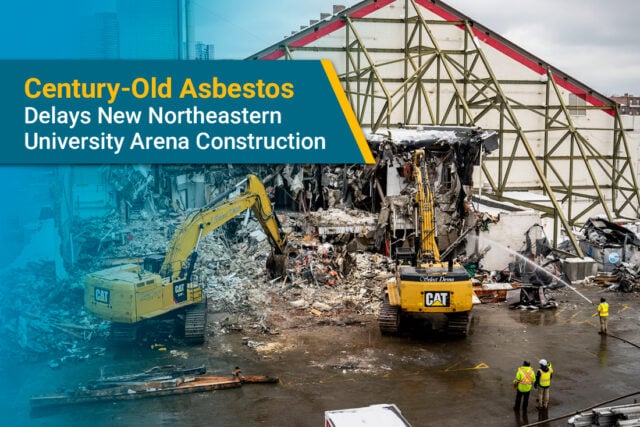
Redevelopment work on the site of Northeastern University’s historic hockey arena in Boston is now facing serious delays, after workers on site discovered asbestos-containing materials in the site’s soil.
The former Matthews Arena was demolished over the course of 2026, with plans to rebuild a more modern multipurpose athletics and recreation facility on the site of the 105-year-old hockey arena. Now, an extensive asbestos abatement will push the planned opening of the new facility back nine months, from fall 2028 to summer 2029.
“Based on the extent of the affected area, the remediation plan will require very controlled removal and appropriate disposal of a substantial amount of soil across the site,” Brett Sweet, senior vice president for finance and administration at Northeastern, said in a statement. “The additional work will impact the timeline of the project.”
More on the Northeastern Asbestos Issues
Up until its demolition earlier this year, the former Matthews Arena stood as the world’s oldest ice hockey arena still in use. The original arena was opened in 1910, and was fully rebuilt in 1920 after a fire. The building notably served as the original home arena for the National Hockey League’s Boston Bruins as well as the National Basketball Association’s Boston Celtics.
Northeastern University purchased the building in 1979, and it hosted the university’s hockey team until its closure last year. According to reports, asbestos materials were discovered during excavation for the foundation of the planned new facility on the same site.
Experts reportedly believe that these asbestos materials could date over 115 years, to fill material used during the Matthews Arena’s original construction from 1909-10. Remediation will need to be completed before construction on the new facility can begin in earnest, requiring a large soil removal effort as well as air quality monitoring during excavation and foundation work.
Legacy Asbestos Rears Its Head
Asbestos is a natural mineral found in the earth’s soil, and for many decades was commonly used in construction for its remarkably effective properties as insulation and flame retardant. However, asbestos use was seriously regulated after the public became widely aware of its links to cancer, especially the deadly cancer known as mesothelioma.
However, “legacy asbestos” still remains in many older homes or buildings that were constructed during the period the mineral was still widely in use. When disturbed, asbestos fibers can easily become airborne, where they pose a serious health risk if breathed in.
Although asbestos use in construction peaked during the years 1940-80, the discovery of asbestos fibers at the Matthews Arena – dating back decades before this period – shows that the risk of legacy asbestos exposure can sometimes be found in places one might not normally expect.
If you find legacy asbestos in your home, office or anywhere else, contact a professional asbestos removal specialist immediately. Do not attempt to remove legacy asbestos yourself from electrical wires, siding, roof shingles, insulation, appliances or old vehicles.
In most cases, your state’s environmental department is responsible for the regulation of asbestos and provides training courses for asbestos handling. Contact your state health or environmental department to learn about asbestos safety.
Sources & Author
- Boston’s Matthews Arena Redevelopment Hits Asbestos. ENR East. Retrieved from https://www.enr.com/articles/63570-bostons-matthews-arena-redevelopment-hits-asbestos. Accessed on 09/15/2026.
- Asbestos discovery delays construction of new athletic facility. The Huntington News. Retrieved from https://huntnewsnu.com/93636/primary-homepage/asbestos-discovery-delays-construction-of-new-athletic-facility/. Accessed on 09/15/2026.
- Photo credit to Matthew Modoono. Northeastern University. Retrieved from https://news.northeastern.edu/2026/03/02/matthews-arena-deconstruction-timeline/. Accessed on 09/16/2026.