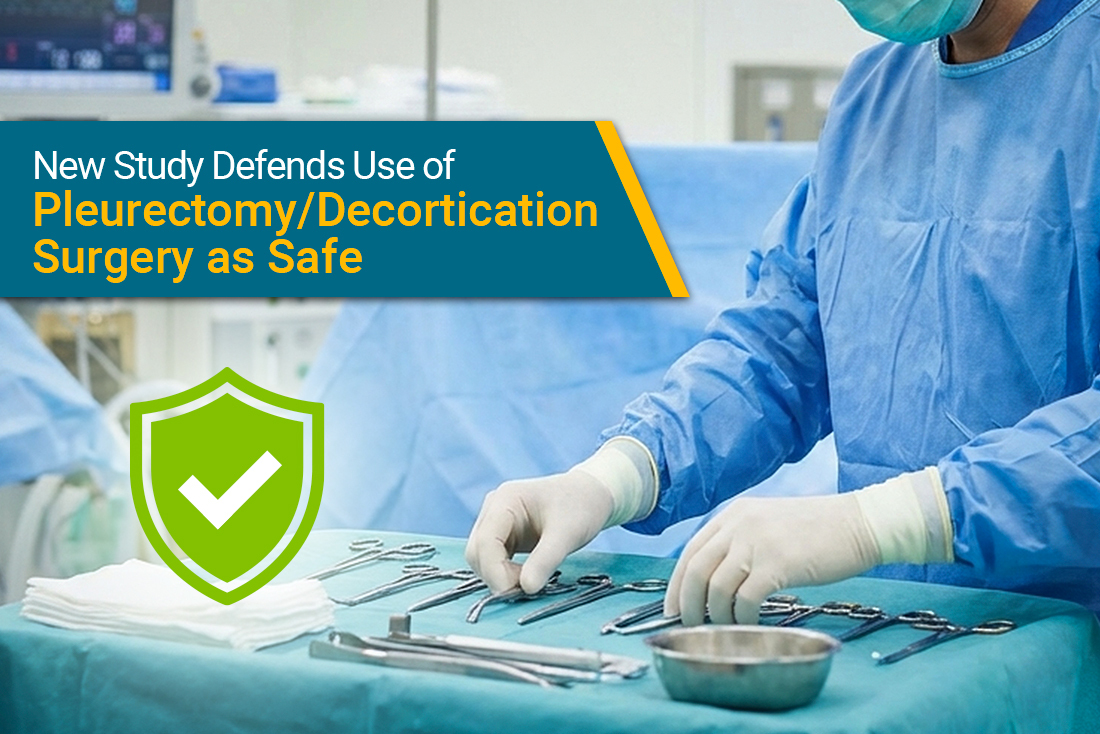
There are risks with any major surgery, especially one intending to aggressively remove cancer. Yet, a new study proves that pleurectomy/decortication surgery for mesothelioma is safe and effective – and should be considered by eligible patients.
Experts at the Icahn School of Medicine at Mount Sinai and the affiliated Mount Sinai Tisch Cancer Center in New York City published extraordinary results regarding the use of pleurectomy/decortication surgery. This study follows another, more controversial study that questioned the safety of the operation.
What Is Pleurectomy/Decortication Surgery?
Pleurectomy/decortication surgery, also called P/D surgery, is a major operation for the rare and aggressive cancer called mesothelioma. This type of cancer starts and grows in the thin linings around the lungs, abdominal cavity, and heart.
P/D surgery is for the type of mesothelioma found in the lining of the lungs: pleural mesothelioma. During P/D surgery, surgeons remove visible tumors by extracting the diseased tissue lining – called the pleura, which covers the lungs. Notably, P/D surgery leaves both lungs intact. Even if tumors are on the surface of the lungs, doctors peel the pleura off of the lungs and hopefully any tumors with it.
An “extended” version of P/D involves removing part or all of the diaphragm and the tissue sac surrounding the heart. The extended version is used to address any small tumor nodules that have spread further than the lining of the lung.
Examining the Results of the MARS2 Study
Mesothelioma and Radical Surgery 2 (MARS2) was a study published in 2024 that questioned the safety of P/D surgery. The trial, which took place across 26 hospitals in the United Kingdom, examined the 30-day and 90-day “mortality rates” following surgery.
A mortality rate is the percentage of people who died following their operation within a given timeframe. 30-day and 90-day mortality rates examine how many people died within 30 and 90 days.
The MARS2 study included 335 patients with mesothelioma. Surprisingly, the group receiving only chemotherapy survived on average longer (24 months) than the group receiving chemotherapy plus surgery (19 months). There were also more serious complications with people receiving surgery, and the 30-day and 90-day mortality rates were 4% and 9%, respectively.
Mount Sinai Tisch Cancer Center Study Offers a Rebuttal
The study at Mount Sinai proves that P/D surgery can be safe. The central differences between it and the MARS2 study are patient selection, imaging use, tumor subtype, and the expertise of the doctors performing the surgery.
In the Mount Sinai study, there were zero 30-day mortalities among 71 people with mesothelioma who underwent P/D surgery. The 90-day mortality rate was only 4.2%.
“Our findings show that pleurectomy/decortication can be done safely when patients are carefully selected and surgery is tailored to balance tumor removal with the patient’s ability to tolerate aggressive treatment,” said Raja M. Flores, MD, professor of Surgery at the Icahn School of Medicine at Mount Sinai, chair of Thoracic Surgery for the Mount Sinai Health System, and corresponding author of the study. “This study highlights that outcomes depend not only on whether surgery is performed, but how and in whom.”
Dr. Flores is one of the top mesothelioma specialists in the world. He has treated people with mesothelioma and researched the disease for more than 20 years. The MARS2 trial spanned 26 hospitals, some of which may not have had an experienced mesothelioma surgeon on staff.
Dr. Flores’ involvement in the Mount Sinai study – and his oversight of the surgeries – likely led to better results. This proves why patients should seek a mesothelioma specialist for surgery, an imperative step for a safe and successful operation.
“This study reinforces that surgery should remain part of the conversation for mesothelioma treatment and can lead to long term survivorship,” Dr. Flores said. “At experienced, high-volume centers, pleurectomy/decortication can be an effective component of multidisciplinary care.
“Surgery is not for everyone, but for the right patients, it can be both safe and meaningful.”
Sources & Author
- Mount Sinai Study Strengthens Landmark Evidence Supporting Lung-Sparing Surgery, Offering Hope for Mesothelioma Patients. Mount Sinai. Retrieved from: https://www.mountsinai.org/about/newsroom/2026/mount-sinai-study-strengthens-landmark-evidence-supporting-lung-sparing-surgery-offering-hope-for-mesothelioma-patients. Accessed: 02/18/2026.
- Disaster on MARS2? Lessons Learned from Modern Day Outcomes of Surgery for Pleural Mesothelioma. Annals of Thoracic Surgery. Retrieved from: https://www.annalsthoracicsurgery.org/article/S0003-4975(26)00105-0/abstract. Accessed: 02/18/2026.
- Extended pleurectomy decortication and chemotherapy versus chemotherapy alone for pleural mesothelioma (MARS 2): a phase 3 randomised controlled trial. The Lancelet. Retrieved from: https://www.thelancet.com/journals/lanres/article/PIIS2213-2600%2824%2900119-X/fulltext. Accessed: 02/18/2026.