Have a medical question?
- Learn about your treatment options
- Ask questions about your diagnosis
- Get doctor recommendations


Written By: David Statman
Mesothelioma immunotherapy is a type of mesothelioma treatment that helps the patient’s immune system fight cancer. The FDA has approved immunotherapy for mesothelioma, which gives another option to patients ineligible for surgery.

Precision Oncology Scientist
Dr. Stephen Williams is a Precision Oncology Scientist in the Department of Pathology and Laboratory Medicine at MD Anderson Cancer Center in Houston, Texas. Dr. Williams served as a medical reviewer, guest blog writer, and medical content writer for Mesothelioma Guide since 2024. He helped the organization inform and educate patients and loved ones about cancer treatment – ensuring all content published on the Mesothelioma Guide website was accurate, concise, and clear. Learn more about Dr. Stephen Williams
Immunotherapy for mesothelioma is a treatment approach that aims to help the body’s immune system recognize and fight mesothelioma cancer cells more effectively. Approved by the FDA in 2020, drugs like Opdivo and Yervoy have shown to extend survival times for patients with advanced, inoperable mesothelioma. This form of treatment offers new hope since it uses the body's natural defenses rather than toxins, often resulting in fewer and less severe side effects compared to traditional therapies like chemotherapy.
Immunotherapy works by activating or enhancing the immune system’s ability to detect and attack cancer cells. Normally, cancer cells can evade immune detection by hiding from immune cells or by actively suppressing immune responses. Immunotherapy drugs intervene in these processes by blocking the mechanisms cancer uses to escape immune attack or by training immune cells to target specific cancer markers. Different types of immunotherapy include checkpoint inhibitors, which block proteins that cancer cells exploit to disable immune defenses, and adoptive cell therapies, like genetically engineered T cells designed to seek out and destroy cancer more precisely.
This treatment is accessible to patients either through FDA-approved options or as part of clinical trials. Eligible patients, often those with unresectable mesothelioma, can pursue immunotherapy in specialized cancer centers across the country. While the costs can be significant, many insurance plans provide coverage, making immunotherapy a viable option for those seeking advanced care. The promising results, including improved survival rates and opportunities for long-term remission, make immunotherapy an important option to consider for patients fighting this challenging disease. As research continues, the future of immunotherapy holds the potential for even more effective treatments and broader accessibility for those affected by mesothelioma.
Mesothelioma immunotherapy helps the patient’s immune system fight mesothelioma. Therapies accomplish this by improving the immune system’s ability to identify and attack mesothelioma tumor cells.
The immune system is a complex network of cells, tissues, and organs. It is responsible for defending the body against diseases, infections, and harmful invaders such as bacteria, viruses, and other pathogens. It identifies and destroys anything it recognizes as foreign or harmful. However, cancers like mesothelioma pose a significant challenge to the immune system due to their unique characteristics.
Cancer develops when normal cells undergo genetic mutations, causing them to grow and divide uncontrollably. Over time, these abnormal cells form a mass known as a tumor. In mesothelioma, these tumors typically develop in the lining of the lungs, abdomen, or heart due to prolonged exposure to asbestos.
What makes cancer particularly difficult for the immune system to combat is it originates from the body’s own cells. Since these mutated cells are derived from healthy tissue, they often retain many characteristics of normal cells.
The immune system relies on certain markers, or antigens, to distinguish between known and unknown. Because cancer cells share most of the same markers as healthy cells, the immune system struggles to differentiate between the two. This allows the cancerous cells to go unnoticed and unchecked.
Adding to the challenge, cancer cells can actively suppress the immune system. They release chemical signals that create an environment where immune cells are less effective, or they exploit immune checkpoints — mechanisms the body uses to prevent autoimmune responses (attacking healthy cells instead of foreign invaders) — to avoid being targeted.
As a result, cancers like mesothelioma can grow and spread without significant interference from the immune system. This unchecked growth can lead to metastasis, where cancer spreads to other parts of the body, making the disease more difficult to treat.
Immunotherapy is a type of mesothelioma treatment that activates the immune system to fight cancer. Immunotherapy tells the immune system how to identify mesothelioma cells in the body and distinguish them from healthy cells.
There are a few ways immunotherapy can be used to help the immune system fight mesothelioma. Some examples are:

Step 1. Immune cells don’t recognize cancerous cells as a threat, which allows them to replicate and spread.

Step 2. Immunotherapy attaches to and kills cancerous cells, which alarms the immune system.

Step 3. The patient’s immune cells recognize cancerous antigens and target cells with similar antigens.

Step 4. The patient’s immune cells seek out the remaining cancerous cells, leaving healthy cells unharmed.
Types of mesothelioma immunotherapy are checkpoint inhibitors, adoptive cell therapy, monoclonal antibodies and oncolytic viruses.
Show Information
Checkpoint inhibitors are a specialized form of immunotherapy that empowers the immune system to better detect and destroy cancer cells. They target specific proteins used by cancer cells to evade the immune response, particularly T cells, which play a central role in defending the body against disease.
Cancer cells exploit natural immune checkpoints — mechanisms the immune system uses to avoid attacking healthy cells — to avoid detection. These checkpoints involve proteins on the surface of T cells and cancer cells. Proteins on cancer cells – such as PD-L1 and B7 – bind to corresponding proteins on T cells, like PD-1 and CTLA-4, effectively “turning off” the T cells’ ability to recognize and attack the cancer.
Opdivo, Yervoy, and Keytruda are approved for the treatment of pleural mesothelioma. The others are still in clinical trial testing.
Show Information
Adoptive cell therapy is a method of genetically changing cells of the immune system to help them fight cancer. Scientists can alter T cells and other immune system cells to direct them to look for cancer cells.
An example of adoptive cell therapy is CAR T-cell therapy. This type of immunotherapy is called cell and gene therapy. Scientists genetically engineer the patient’s T cells to look for cancer cells carrying a specific protein. For mesothelioma, the CAR T cells are engineered to target the protein mesothelin, which is found on the surface of mesothelioma cells.
The patient’s T cells are collected from their blood and genetically modified in a laboratory to more effectively target the patient’s cancer. These new and improved T cells are multiplied and returned to the patient’s blood to begin attacking the disease.
CAR T-cell therapy has shown remarkable success in treating certain blood cancers, such as leukemia and lymphoma, and researchers are actively exploring its potential for solid tumors like mesothelioma. While it is a complex and resource-intensive treatment, CAR T-cell therapy represents a breakthrough in personalized cancer care, offering hope for patients with aggressive or treatment-resistant cancers like mesothelioma.
CAR T-cell therapy for mesothelioma is in clinical trial testing.
Show Information
Monoclonal antibodies are a type of immunotherapy that enhances the immune system’s ability to recognize and attack cancer cells by targeting specific proteins. These lab-engineered antibodies are designed to bind to protein receptors found on the surface of cancer cells or immune cells, such as T cells.
By doing so, they serve as a bridge, effectively marking the cancer cells for destruction and facilitating an immune response. In mesothelioma treatment, monoclonal antibodies can also block signals that cancer cells use to grow and spread, or deliver toxic substances directly to the cancer cells.
These therapies are currently being tested in clinical trials and represent a growing area of hope for patients with mesothelioma.
Show Information
Oncolytic viruses are modified versions of viruses – such as the herpes simplex virus – used to infect cancer cells. Oncolytic viruses are engineered to infect only cancer cells while ignoring healthy cells, which keeps patients safe.
By infecting cancer cells, the virus causes the cancer cells to die and release certain proteins, which are called antigens. The release of these antigens acts as a distress signal, alerting the immune system and prompting it to identify and attack other cancer cells bearing the same proteins.
By combining direct tumor destruction with the activation of an anti-cancer immune response, oncolytic viruses represent a dual-action therapy with significant potential. They are being actively researched for various cancers, including mesothelioma, and have shown promise in early clinical trials as a powerful tool in the fight against aggressive tumors.
ONCOS-102 is an example of an oncolytic virus for mesothelioma. It is currently in clinical trial testing.
People can receive immunotherapy for mesothelioma either through an FDA approval or enrollment in a clinical trial.
People with malignant pleural mesothelioma may be eligible for immunotherapy through an FDA approval. Eligibility depends on whether the patient can have surgery or not.
Clinical trials are another option for patients, including people with malignant peritoneal mesothelioma. These studies test novel immunotherapies on their own or in combination with other treatment options, including surgery and chemotherapy.
Each clinical trial has specific enrollment criteria that patients must meet. The criteria usually accepts patients based on their stage, cell type, and treatment history.
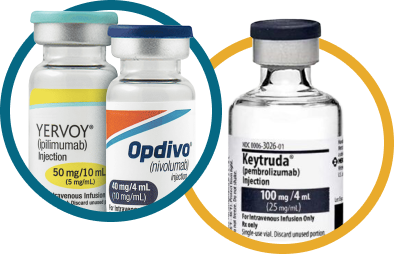
The three mesothelioma immunotherapy drugs with FDA approvals are:
All three are approved by the U.S. Food and Drug Administration (FDA) for unresectable malignant pleural mesothelioma. “Unresectable” is the medical term for when surgery is not an option.
In 2020, the FDA approved Opdivo and Yervoy for mesothelioma for use together. In 2024, the FDA approved Keytruda for mesothelioma in combination with chemotherapy.
“I think the dual immunotherapy protocol of Opdivo and Yervoy is one of the best innovations in mesothelioma treatment. It used to be that all you had was surgery. We’d do it and there wasn’t another avenue. I’m not a believer in a single bullet for cancer.”
<a href="https://www.mesotheliomaguide.com/doctors/dr-daniel-labow/">Dr. Daniel Labow</a>
Mesothelioma Specialist
The main benefit of immunotherapy for mesothelioma is the treatment’s ability to activate the patient’s own immune system against cancer. This can control the disease and even put patients into remission.
“We know cancer is a disease of genetic mutations,” says Dr. Ezra Cohen, of the University of California San Diego Health, “and some of those mutations are revealed to the immune system through immunotherapy.”
Dr. Ezra Cohen
University of California San Diego Health
Immunotherapy also differs significantly from chemotherapy. Immunotherapy does not pour toxins into the patient’s body. Patients usually experience much fewer and less severe side effects from immunotherapy than chemotherapy.
The success rates of mesothelioma immunotherapy are promising. The average mesothelioma survival for people receiving FDA-approved immunotherapy drugs is approximately 19 months.

75% of patients live for at least one year after they begin treatment

41% of patients live for at least two years after they begin treatment

23% of patients live for at least three years after they begin treatment
These survival rates are significantly better than those associated with chemotherapy.
The FDA approval of Opdivo and Yervoy came after the immunotherapy combination outperformed chemotherapy in a large clinical trial. Opdivo and Yervoy gave patients a median survival of 18.1 months. Chemotherapy was attributed with a median survival of 14 months.
“When we see differences of 2-5 months, we think it’s a huge deal,” says Dr. Raja Flores, a mesothelioma specialist at Mount Sinai Health System.
Some people are achieving long-term cancer remission thanks to mesothelioma immunotherapy:
These success stories of long-term survival from mesothelioma immunotherapy deserve to be highlighted. Yet, patient expectations should be tempered. Long-term survival (five or more years) is rare without surgery.
Immunotherapy can be especially beneficial for mesothelioma patients diagnosed with the biphasic or sarcomatoid cell types. These cell types are rarer and can be especially difficult to treat with surgery.

In a study of 179 people with mesothelioma, patients with biphasic and sarcomatoid cell types had a 1-year survival rate of 76.2% after immunotherapy. The 1-year survival rate is much lower for people who did not receive immunotherapy.
The side effects of mesothelioma immunotherapy are usually manageable, especially compared to chemotherapy. The main side effects of mesothelioma immunotherapy are:

Fatigue

Nausea

Constipation/
Diarrhea

Coughing

Joint Pain

Decreased
Appetite
Patients can receive mesothelioma immunotherapy at mesothelioma cancer centers of excellence. These cancer centers are located throughout the United States. These treatment centers can also work with a local facility to direct immunotherapy treatment so patients can remain close to home to receive their therapy.
The treatment centers follow official protocol to provide mesothelioma immunotherapy to patients who are eligible through an FDA approval or a clinical trial.

Below are examples of mesothelioma cancer centers offering immunotherapy treatment or directing treatment with local treatment facilities:
The cost of mesothelioma immunotherapy can be expensive, but health insurance plans usually cover a portion of this cancer treatment.
It is important to be knowledgeable of your medical insurance plan and understand your deductible, out-of-pocket maximum, in-network providers, and more. You should also keep track of medical records and bills to ensure you receive appropriate insurance coverage.
Clinical trials are one way to offset the cost of treatment. Many of the costs of immunotherapies are covered by the hospital or the manufacturing company sponsoring the trial. Talk with your mesothelioma specialist for more information about the clinical trials at cancer centers.
The future of mesothelioma immunotherapy is promising. Experts expect more immunotherapy treatments to advance through development and testing. They also hope that more personalized approaches to cancer treatment means more options and better access for patients.
Patients may also benefit from future advancements in using immunotherapy with other mesothelioma treatment options, such as surgery. A study of 179 patients tested several combinations of mesothelioma treatment. Immunotherapy with surgery and chemotherapy performed the best: median survival of 22.6 months.

The immunotherapy drugs approved for mesothelioma are Opdivo, Yervoy and Keytruda. The U.S. Food and Drug Administration (FDA) approved Opdivo and Yervoy for unresectable malignant pleural mesothelioma. Opdivo and Yervoy are approved for use as a combination. Keytruda is approved for unresectable malignant pleural mesothelioma in combination with chemotherapy.
Immunotherapy treats mesothelioma by helping the immune system look for and attack cancer cells. The immune system struggles to tell the difference between cancer cells and healthy cells. Immunotherapy activates the immune system against cancer by looking for specific proteins on the surface of mesothelioma cells.
The side effects of immunotherapy for mesothelioma are: fatigue, coughing, nausea, decreased appetite, constipation, joint pain, and diarrhea. Most patients won’t experience all of these side effects, and are often manageable with medication. More serious side effects include allergic reactions to the therapy, resulting in itching, rash, wheezing, or flushing of the face.
The average mesothelioma prognosis for people receiving immunotherapy is 1-2 years. In a large study of nearly 600 people with mesothelioma treated with the immunotherapy drugs Opdivo and Yervoy, the average survival time was 18.1 months. This average survival time is better than that of chemotherapy. Some patients have achieved long-term survival of more than three years thanks to immunotherapy.
People can go to cancer centers or local medical facilities for mesothelioma immunotherapy treatment. Mesothelioma Guide recommends going to a top mesothelioma cancer center first to learn all your treatment options and discuss your immunotherapy treatment plan with a mesothelioma specialist. Some of the top mesothelioma cancer centers are: