Have a medical question?
- Learn about your treatment options
- Ask questions about your diagnosis
- Get doctor recommendations


Written By: David Statman
Most mesothelioma patients are male, but there are close to 1,000 women with mesothelioma diagnosed in the United States each year. Around 22% of all mesothelioma cases involve women, and non-occupational asbestos exposure tends to be the cause.

Mesothelioma Patient Advocate
Karen Ritter, a registered nurse, is the lead patient advocate for Mesothelioma Guide. She has a deep passion for patient care, which includes helping patients and their families search for treatment options at the top mesothelioma cancer centers. She finds the balance between encouraging patients to receive the best treatment possible while enjoying their time with loved ones and friends. Karen is a valuable asset for patients due to her knowledge of mesothelioma, compassion for the victims of this disease and dedication to guiding patients through their treatment journey. Learn more about Karen Ritter, RN BSN
Women diagnosed with mesothelioma typically face a different set of circumstances compared to their male counterparts. While most mesothelioma cases occur in men due to occupational exposure in industries like construction, manufacturing, and shipbuilding, women most often develop the disease through non-occupational exposure. This might include household contact with asbestos fibers brought home on clothing or exposure in environments not directly related to work. Each year, nearly 1,000 women in the United States are diagnosed with mesothelioma, which accounts for about 22% of all cases. Understanding how women develop this disease can help provide clarity and support for those affected by it.
There are two main types of mesothelioma that women are most commonly diagnosed with. Pleural mesothelioma affects the lining of the lungs and is the most common form, accounting for around 80% of all cases. Women tend to develop pleural mesothelioma at an average age of 62, typically after inhaling the tiny asbestos fibers that become lodged in the lining of the chest. The other primary type is peritoneal mesothelioma, which affects the lining of the abdominal cavity and accounts for about 20% of cases. Women with peritoneal mesothelioma are usually diagnosed at a younger age, averaging approximately 53 years old, and most often develop the disease from swallowing or ingesting asbestos fibers that reach the stomach area.
Unlike men, who frequently experience mesothelioma due to direct occupational exposure, women are more likely to develop the disease from non-occupational sources. A notable study from 2015 indicated that nearly 88% of women with mesothelioma had been exposed to asbestos outside of work settings. This can include exposure from environmental sources, family members' occupational dust, or imported products containing asbestos. This distinction highlights the importance of understanding different exposure pathways and emphasizes that mesothelioma can affect anyone, regardless of their work history. For women and their families, recognizing these potential exposure points can be a step toward early diagnosis, better understanding, and compassionate support on their health journey.

Pleural mesothelioma is the most common type of this rare cancer. According to a study published in Lung Cancer International, pleural mesothelioma accounts for approximately 80% of all mesothelioma cases.

Women are more likely to develop pleural mesothelioma than other types of this cancer. According to Duke University researchers, around 78% of women with mesothelioma have the pleural variety. Their average age is 62.
Pleural mesothelioma forms primarily due to inhaling asbestos fibers. When fragmented asbestos dust is in the air, people nearby can breathe in the toxin. The fibers then travel into the thorax and can lodge into the cellular lining within the pleura, which is a thin membrane separating the lung cavity and chest wall.

Peritoneal mesothelioma is the second most common type of the disease. This diagnosis comprises around 20% of all mesothelioma cases. Women are the victims in close to half of peritoneal mesothelioma cases.

Duke University researchers found that around 22% of women with mesothelioma have peritoneal. Their average age at diagnosis is 52.8, nearly 10 years younger than the average for pleural mesothelioma.
Peritoneal mesothelioma develops primarily from swallowing (ingesting) asbestos fibers. The fragments of asbestos can travel from the mouth to the stomach and then lodge into the peritoneum, which is a thin membrane wrapping around the abdominal cavity.
Occupational asbestos exposure is the most common cause of mesothelioma. This method accounts for at least 80% of all mesothelioma cases and nearly 100% of male cases.
This fact explains why mesothelioma affects males more than females.
However, occupational asbestos exposure is not the primary reason why women get mesothelioma.

A 2015 study published in Translational Oncology states that women are more likely to be the gender associated with non-occupational asbestos exposure. According to the study, women comprise 87.5% of non-occupational exposure cases.
The three primary exposure methods for women are:

Secondhand asbestos exposure

Household exposure and appliances

Talc-based cosmetic products
A 2019 study conducted by Duke University researchers backed up this long-held belief. The team found that “a majority of the (women with mesothelioma) were exposed to asbestos through a household contact.”

Secondhand asbestos exposure, also called “secondary asbestos exposure,” happens quite often, especially for women. Since males often worked with asbestos in their occupations, they frequently brought home toxic dust that was on their clothes or other belongings. Women also were at risk of washing their loved one’s asbestos-ridden clothes.

Women were — and still are — at risk of asbestos exposure through household products and appliances. Objects or household components that include heat all could contain asbestos. The manufacturers of most of these everyday household items used asbestos to protect them from fires.
Throughout the 20th century, women were the primary home caretakers. They regularly used many of these products to cook food, clean clothing, wash dishes, and handle more daily tasks involving asbestos exposure.

In the 21st century, researchers have uncovered another way people are exposed to asbestos: through using talc-based products.
Talc, like asbestos, is a mineral mined for commercial goods. The mineral is turned into a powder form (called “talcum powder”) that can soothe dry or irritated skin.
Talcum is associated with mesothelioma because of the mineral’s link to asbestos. The two cohabitate the earth and often are found close to one another. Mining for talcum often results in asbestos contamination, and people who use talc-based products may expose themselves to asbestos.
The United States Food and Drug Administration routinely conducts tests of cosmetic products, and in 2019 the organization uncovered asbestos in samples of Johnson & Johnson’s baby powder. Women frequently use this product on children, and they likely were exposed to asbestos.
In May 2020, Johnson & Johnson ceased production and sale of its baby powder product in the U.S. and Canada. The decision stems from increased concerns regarding the link between the talc-based product and mesothelioma. Johnson & Johnson Baby Powder has been promoted as a brand since the 1890s.
The first study, published in the Journal of Occupational and Environmental Medicine, revealed that asbestos-tainted talc could cause mesothelioma. The researchers analyzed 33 mesothelioma patients who all had one shared trait: talc powder as their only substantial asbestos exposure method.
Of those 33 patients, 26 were women. Researchers noted that females were at a higher risk than males of exposure through using talc products.
Our case study suggests that cosmetic talcum powder use may help explain the high prevalence of idiopathic mesothelioma cases, particularly among women.
Dr. Jacqueline Moline
Hofstra/Northwell School of Medicine
The second study, which was published in the American Journal of Industrial Medicine, analyzed 75 people with mesothelioma. Their only known exposure method was from talc-based cosmetic products. Of the 75 cases analyzed, 64 were women.
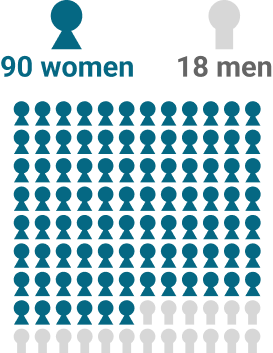
These two studies combine for 108 reported cases, 90 of which (83%) were women.
In addition to listing percentages of each form of mesothelioma, the Duke University study broke down how often women are diagnosed with each mesothelioma cell type. The researchers analyzed 354 cases and found that:

Statistics covering both genders indicate that between 50% and 70% of all cases are epithelioid mesothelioma. Women are more likely than men to have this cell type, which is positive news for women with mesothelioma: Epithelioid mesothelioma is attributed to a longer survival time.

Epithelioid mesothelioma cells tend to clump together, have an elongated and visible nucleus, and show a pink cytoplasm. Epithelioid mesothelioma cells are more easily identifiable during surgery and other treatments, which makes this specific diagnosis more treatable.

Sarcomatoid mesothelioma cells have an overlapping, irregular shape and an enlarged and elongated nucleus or nuclei. Sarcomatoid mesothelioma cells are tougher to identify during treatment, metastasize quickly and usually correlate with a worse prognosis than epithelioid cells.

Biphasic mesothelioma is a combination of both epithelioid and sarcomatoid cells. To be diagnosed with biphasic mesothelioma, the patient’s disease must include at least 10% of both cell types.
Treatment for mesothelioma includes surgery, chemotherapy, radiation, and emerging methods like immunotherapy. The treatment a patient receives depends on their diagnosis, age, health, and other factors.
The two primary surgeries for women with pleural mesothelioma are extrapleural pneumonectomy (EPP) and pleurectomy with decortication (P/D):

EPP removes the affected lung, pleural cavity, and other areas impacted by metastasis.

P/D is a lung-sparing operation that takes out just the pleural cavity and other affected areas (such as the diaphragm and pericardium).
EPP is usually best for women with a more advanced form of pleural mesothelioma. P/D is often best for women with early-stage pleural mesothelioma.
A study published on the Journal of National Comprehensive Cancer Network compared treatment rates between men and women. The report found that women were less likely to receive life-saving therapy.

The study confirmed that around 22% of pleural mesothelioma cases involve women. Despite better survival rates than men, women were not as likely to undergo chemotherapy or surgery.
Women have a much better mesothelioma survival rate than men. According to a study published in the Annals of Thoracic Surgery, approximately 13.4% of women survive for 5 years following their diagnosis. Only 4.5% of males survive for this long. Survival rates for women are across-the-board better than they are for men.
According to the Annals of Thoracic Surgery

Around half of women with mesothelioma survive for at least one year, but only 40% for men do.

Approximately 30% of women survive for at least two years, but only 20% of men do.

Around 25% of women survive for three years, compared to just 15% of men.
There are numerous reasons why women survive mesothelioma for longer than men. Many of the explanations tie to the fact that women often are exposed to asbestos in non-occupational settings.
According to a study published in Translational Oncology, non-occupational exposure often causes peritoneal mesothelioma. Numerous studies show that peritoneal mesothelioma patients live longer than those with pleural mesothelioma.
According to the Translational Oncology article

An estimated 91% of peritoneal mesothelioma patients survive for one year, while only 73% of pleural mesothelioma patients do.

Around 74% of peritoneal mesothelioma patients survive for at least three years, compared to just 23% of those with pleural mesothelioma.

Nearly 40% of peritoneal mesothelioma patients survive for at least 10 years, and only 5% of pleural mesothelioma patients survive for this long.
Age at the time of diagnosis is another reason why women live longer than men. Numerous studies show women are likely to be diagnosed at a younger age than men are. Women are also more likely to notice symptoms and seek medical care immediately.
The reasoning for this is most likely due to the asbestos exposure method. According to the Translational Oncology study, non-occupational asbestos exposure usually means a shorter “latency period,” which is the time a disease takes to develop.
The mesothelioma latency period is usually between 20 and 50 years. However, women may develop the cancer sooner than 20 years. A quicker development leads to a younger age at diagnosis, which often means a healthier patient and more aggressive, curative-focused treatment.

Men are far more likely than women to get mesothelioma. Males account for between 75% and 80% of all cases. Asbestos exposure usually occurs in jobs more likely to be worked by men. However, the number of cases involving women is rising due to the increase in non-occupational exposure cases.
Women are most likely to get pleural mesothelioma. According to numerous studies, around 75% of women with mesothelioma have this form of the cancer. However, women are often linked to peritoneal mesothelioma, a cancer of your abdominal lining, because men rarely get this type of the cancer.
Women are often exposed to asbestos from a loved one who worked directly with the dangerous mineral. This is called secondary asbestos exposure (or secondhand exposure). Other ways women get mesothelioma are from:
In one study, around 50% of women survived for one year after diagnosis, compared to 40% of men. Women are more likely to seek medical attention sooner after noticing alarming symptoms. Women are often diagnosed at an earlier age than men, which leads to a better prognosis.