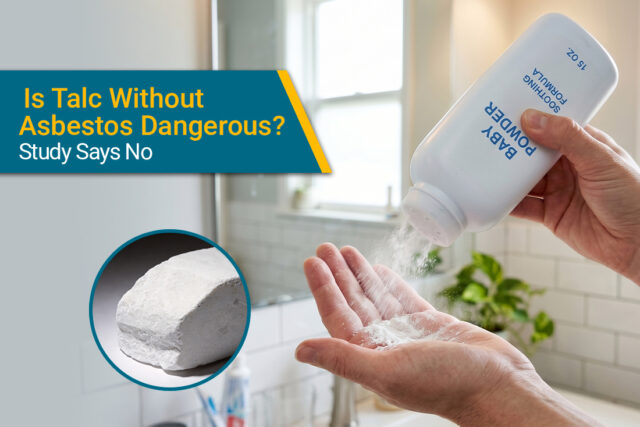
A scientific paper seems to prove that asbestos is the culprit for many respiratory cancers, especially mesothelioma, and talc without asbestos is not dangerous.
Talc has long been connected with mesothelioma and other cancers, including lung cancer and ovarian cancer. The mineral was used in cosmetics and baby powder to absorb moisture and keep skin healthy. People who used talc cosmetics on their skin or their children’s skin were considered at a higher risk of developing cancer later in life.
However, the true reason for the cancer risk is the presence of asbestos in talc. Findings published in the Journal of Thoracic Oncology show asbestos-free talc is seemingly safe – and talc with asbestos is a threat.
What Is Asbestos?
Asbestos is a natural mineral found in many of the same geographic locations as talc. Exposure to asbestos causes mesothelioma, lung cancer, ovarian cancer, and more.
Mesothelioma is a rare type of cancer forming in the lining of the lungs, abdominal cavity, heart, or testes. Only 2,500 people in the United States are diagnosed each year. The only known cause of this cancer is exposure to asbestos, and most victims are exposed through their jobs. Miners can be exposed when mining for talc that is near asbestos in the earth’s soil.
Mining for talc can inadvertently lead to asbestos contamination in talc products after manufacturing. Johnson & Johnson Baby Powder was a popular brand during the 20th century and the start of the 21st century. Johnson & Johnson currently faces approximately 60,000 lawsuits from people who used the company’s baby powder and later developed cancer – believing asbestos was in the talcum powder.
Examining Asbestos-Free Talc
A research team led by Paolo Boffetta at Stony Brook Cancer Center identified 28 studies focusing on lung cancer, mesothelioma, and laryngeal cancer. Their analysis focused on talc miners and millers who handled and were exposed to talc testing negative for asbestos.
The research found:
- No increased risk of lung cancer
- No mesothelioma cases reported
- No laryngeal cancer cases reported
Other News: Lancelet Retracts 1970s Study About Talc Safety
In other news related to talc and cancer, the medical journal The Lancet retracted a study published in 1977 claiming talc is safe for consumers. The original article stated, “There is no reason to believe that normal consumer exposure to cosmetic talc has in the past led either to cancer at any site or to measurable loss of lung function.”
The Lancet found that the commentary was authored by Francis J.C. Roe, a consultant for the aforementioned Johnson & Johnson. This significant conflict of interest questions the credibility of the article. The Lancet even called it “a clear breach of publishing ethics” and stated that editors would not have published the commentary if they were aware of the author’s relationship with Johnson & Johnson.
The retraction of the study shines more light on the danger of talc contaminated with asbestos. There have been several studies linking asbestos to talc, and the U.S. Food and Drug Administration and the Environmental Protection Agency both conducted tests finding traces of asbestos in talc.
Sources & Author