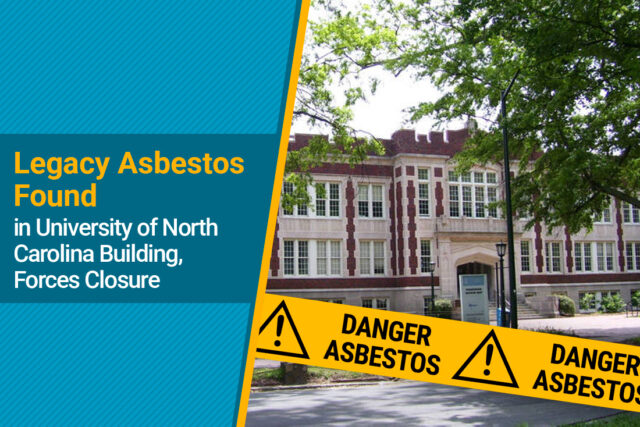
Renovations of an academic building at the University of North Carolina are being delayed by months after HVAC work revealed the presence of asbestos throughout a sizable part of the building, according to a report over the weekend.
Renovation work on the University of North Carolina’s Phillips Hall, the central building of the university’s mathematics department, began in January with a targeted end date of January 2027. However, recently discovered asbestos will push the process back several months.
The renovations had previously forced a number of students and faculty to relocate to other buildings, and caused a number of classes to be moved as well. Asbestos has been found in a number of pipes throughout the building, as well as floor tiles and HVAC equipment. However, part of the building will remain in use.
“Per the campus asbestos control program, surveys are conducted prior to repair work or renovations to identify asbestos containing materials that will be potentially disturbed,” according to a university spokesperson. “The identified material is abated per regulations.”
More on Asbestos at the University of North Carolina
Asbestos has historically been commonly found throughout a number of buildings over a certain age, as the mineral was widely used as insulation and flame retardant throughout the United States up until the 1980s.
The University of North Carolina had previously reported that over 40 buildings on its campus still have asbestos. Phillips Hall, which opened in 1919, has previously gone through several rounds of asbestos abatement.
Hazardous materials inspection for the current HVAC upgrade in the building was performed in 2024, but the company that performed the inspection noted that its access to a number of the building’s classrooms and laboratories was restricted, potentially allowing asbestos to be missed in parts of Phillips Hall.
Although asbestos is not particularly dangerous when packed away where people cannot be exposed to it, when disturbed it easily becomes airborne. When breathed in, asbestos exposure has been linked to a number of cancers, and is the only known risk factor for the deadly cancer known as mesothelioma.
What the Asbestos Closure Means
The closure of parts of Phillips Hall for asbestos is another example of a frequent trend, where older academic buildings that still remain in everyday use are forced to close for asbestos abatement after harmful materials were unexpectedly discovered during construction or renovation work – often forcing abrupt closures and relocation of students and faculty.
Although asbestos hasn’t been used in new construction for decades, the risk of legacy asbestos – or asbestos that remains in older buildings or homes – is still widely present and poses a significant risk especially to construction or renovation workers.
If you find legacy asbestos in your home, office or anywhere else, contact a professional asbestos removal specialist immediately. Do not attempt to remove legacy asbestos yourself from electrical wires, siding, roof shingles, insulation, appliances or old vehicles.
In most cases, your state’s environmental department is responsible for the regulation of asbestos and provides training courses for asbestos handling. Contact your state health or environmental department to learn about asbestos safety.
Sources & Author
- Harmful asbestos was detected in Phillips Hall — what’s being done? The Daily Tar Heel. Retrieved from https://dailytarheel.com/482993/university/harmful-asbestos-has-been-detected-in-phillips-hall-what-is-being-done/. Accessed on 09/28/2026.
- Photo credit: Krause, Jennifer, “Phillips Hall,” Carolina Story: Virtual Museum of University History. Retrieved from https://museum.unc.edu/items/show/1622. Accessed on 09/29/2026.