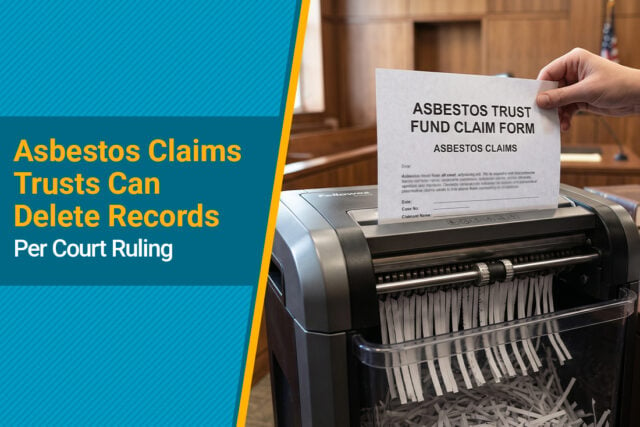
Asbestos claims trusts won a court victory last week when the Delaware Supreme Court reversed an October chancery court ruling, stating that asbestos claims trusts cannot delete information from exposure claims more than a year old.
A group of asbestos litigation defendants and bankruptcy debtors, including the pharmaceutical giant Johnson & Johnson, had in April 2025 filed a lawsuit attempting to prevent asbestos trusts from wiping claims records. Johnson & Johnson and the other defendants have previously used such records to attempt to limit their liability in mesothelioma lawsuits and argue down settlements.
But while the litigation defendants originally received a ruling in their favor last year, the Delaware Supreme Court instead unanimously found that the ruling was overly broad and did not apply to any specific case, and overturned it as too generalized.
“The absence of an identifiable pending or anticipated action at law leaves the court with no gauge with which to measure the appropriate scope of the bill,” said Delaware Supreme Court Justice Gary F. Traynor.
What This Ruling Means for Mesothelioma Lawsuits
This lawsuit was filed against 10 asbestos claims trusts after Johnson & Johnson and other asbestos defendants – including Dow Chemical, one of the largest chemical companies in the world – learned of their new policies to delete on a rolling basis information from asbestos exposure claims.
Although the trusts said that the new deletion policy was meant to protect sensitive personal information, these asbestos defendants said that it amounts to destruction of evidence in ongoing lawsuits against them for asbestos exposure leading to injury and death from mesothelioma and other cancers.
“It is reasonably conceivable that without access to the claims data, the repeat litigants will lose more cases and settle more claims for larger payouts,” said Delaware Chancery Court Vice Chancellor J. Travis Laster in October, after he originally ruled in favor of the companies’ complaint.
In past asbestos cases, claims data from settlement trusts have been ruled discoverable and allowed to be used in court. In these cases, Johnson & Johnson and other asbestos defendants have used this data to argue that plaintiffs have been exposed to asbestos in ways that limit their responsibility, and to argue they should pay less in settlements.
As tens of thousands of mesothelioma lawsuits proceed against Johnson & Johnson in courts across the United States, this ruling means that the multinational corporation has lost another tactic it has repeatedly attempted to limit its liability in court.
More on Johnson & Johnson Asbestos Lawsuits
As of July 2026, Johnson & Johnson continues to face over 60,000 lawsuits over allegations that its talc-based products caused mesothelioma or ovarian cancer after being contaminated with asbestos.
Plaintiffs have introduced internal company records and expert testimony that they contend show Johnson & Johnson knew about possible asbestos contamination and failed to adequately warn consumers. Johnson & Johnson disputes those allegations and continues to defend the safety of its former talc products.
The company discontinued sales of talc-based Johnson’s Baby Powder in the United States and Canada in 2020 amid declining demand and mounting litigation. It stopped selling talc-based baby powder globally in 2023 and transitioned to a cornstarch-based formula.
Johnson & Johnson has repeatedly attempted many tactics to avoid paying judgments or have lawsuits thrown out of court, but still regularly are hit with verdicts in the tens of millions. Most recently, the corporation announced that it had reached a $5.5 billion settlement to resolve about 76,000 claims relating to ovarian cancer. Mesothelioma claims are unaffected and remain ongoing.
Mesothelioma compensation can cover the high costs of treatment and the challenges that come with lost wages from not being able to work due to declining health. Victims such as yourself or your loved one with cancer deserve this financial help, paid directly from the company responsible for bringing asbestos into your home.
Contact our patient advocates to learn about your compensation options. Email Carl Jewett at cjewett@mesotheliomaguide.com to learn if your cancer diagnosis and use of Johnson & Johnson Baby Powder could lead to a settlement or verdict.
Sources & Author
- Del. Supreme Court Ends J&J Bid To Preserve Asbestos Data. Law360. Accessed from https://www.law360.com/articles/2508421/del-supreme-court-ends-j-j-bid-to-preserve-asbestos-data. Retrieved on 08/04/2026.
- Chancery Lets J&J, Dow Fight To Save Asbestos Data. Law360. Accessed from https://www.law360.com/articles/2403939/chancery-lets-j-j-dow-fight-to-save-asbestos-data. Retrieved on 08/04/2026.
- J&J reaches sweeping talc deal that could end decade of litigation. NBC News. Accessed from https://www.nbcnews.com/business/business-news/jj-reaches-sweeping-talc-deal-end-decade-litigation-rcna589575. Retrieved on 08/04/2026.