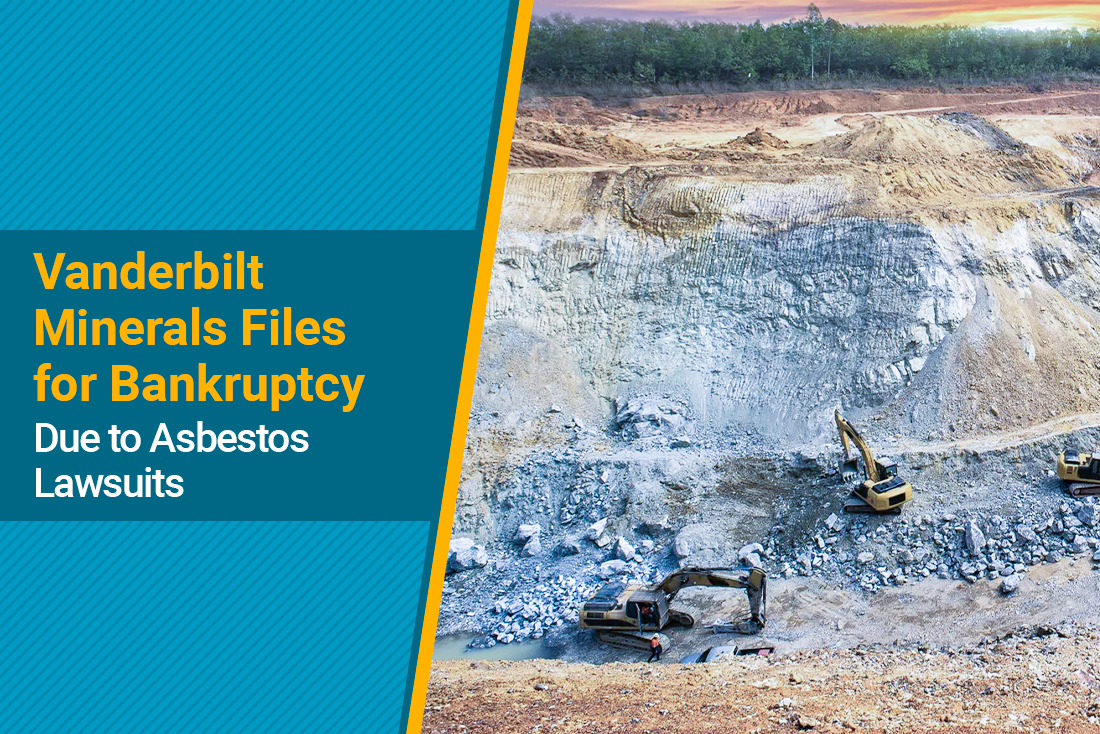
Vanderbilt Minerals, a company that once mined for talc to use in industrial products, has filed for bankruptcy. The company is a defendant in more than 1,400 lawsuits related to asbestos exposure.
Vanderbilt Minerals submitted a bankruptcy filing in court. In the filing, the company stated it plans to hold an auction for its assets. The opening offer is $50 million from Commodore Materials.
As part of the bankruptcy, the company likely must create an asbestos trust fund to set aside funds for future legal claims involving asbestos exposure.
Accusations Against Vanderbilt Minerals
Vanderbilt Minerals is accused in lawsuits of once selling items contaminated by asbestos. While the company denies that its products contained asbestos, the substance is a natural mineral found in the earth’s soil.
So, too, is talc, which is used in cosmetics and for some industrial products. Talc and asbestos can be found in the same geographic areas, so mining for talc products can lead to contamination from asbestos. Vanderbilt Minerals’ mining practices likely inadvertently grabbed asbestos and mixed it into products then sold for industrial use.
Vanderbilt Minerals, which is based in Norwalk, CT, spent a reported $8 million on talc-related lawsuits last year. The company’s chief restructuring officer said there’s another $117 million in talc-related costs coming against the company with the pending asbestos lawsuits.
Vanderbilt Minerals stopped mining for talc in 2008.
Asbestos and Cancer
Asbestos is problematic due to the link to several types of cancer. The most notorious type is mesothelioma, a rare cancer that spreads quickly. Exposure to asbestos is the only cause of mesothelioma.
Asbestos also can cause ovarian cancer and lung cancer. Sharp fibers can be inhaled or swallowed and get captured in tissue linings in a person’s body. These fibers can irritate cells and cause them to mutate into cancer.
In 2024, a jury ruled that Vanderbilt Minerals must pay $15 million to the family of a man who died of mesothelioma. A judge later increased the amount to $22.5 million. The family accused the company of exposing their deceased loved one – a father of three – to asbestos-contaminated talc while working as a process engineer at the General Electric plastics plant.
Why Companies File for Bankruptcy
Companies linked to asbestos exposure often file for bankruptcy. Companies revolved their entire business model around manufacturing and selling asbestos during the 20th century. Before the public knew asbestos was dangerous, companies mined for the mineral and sold it for use in various industries. Most of these companies are now bankrupt due to the pile of cancer lawsuits filed against them – and the multi-million-dollar verdicts they were forced to pay.
Now, companies are often linked to asbestos inadvertently. Still, potentially lackadaisical mining and manufacturing practices can lead to asbestos contamination of certain products – such as those featuring talc.
Johnson & Johnson, a popular health and beauty company, faces more than 60,000 pending lawsuits due to people with cancer claiming they were exposed to asbestos from using the company’s products. Johnson & Johnson has tried three times to file for bankruptcy, and all three were blocked by a judge.
Companies file for bankruptcy to avoid facing lawsuits from victims. A bankrupt company cannot be taken to court. Instead, they create a trust fund with money set aside to pay out future claims. Many companies linked to asbestos exposure create “shell” companies that hold the asbestos liabilities and file for bankruptcy – a practice known as the “Texas Two-Step” that allows companies to continue operating while separating from any asbestos liabilities.
Sources & Author
- Asbestos Lawsuits Prompt Vanderbilt Minerals to File Bankruptcy. Insurance Journal. Retrieved from: https://www.insurancejournal.com/news/national/2026/02/18/858334.htm. Accessed: 02/25/2026.