Thousands of people in the United States each year develop mesothelioma, which is a cancer caused by exposure to asbestos. Tens of thousands more people develop lung cancer and ovarian cancer from asbestos exposure.
One of the methods of exposure is from using talc cosmetics. There are nearly 60,000 lawsuits pending against Johnson & Johnson for the contamination of asbestos in talc-based baby powder. Johnson & Johnson decided to stop manufacturing talc products – a step taken by other companies as well.
Yet, despite this growing evidence that talc can be unsafe, the U.S. Food and Drug Administration (FDA) recently decided it’s not unsafe enough.
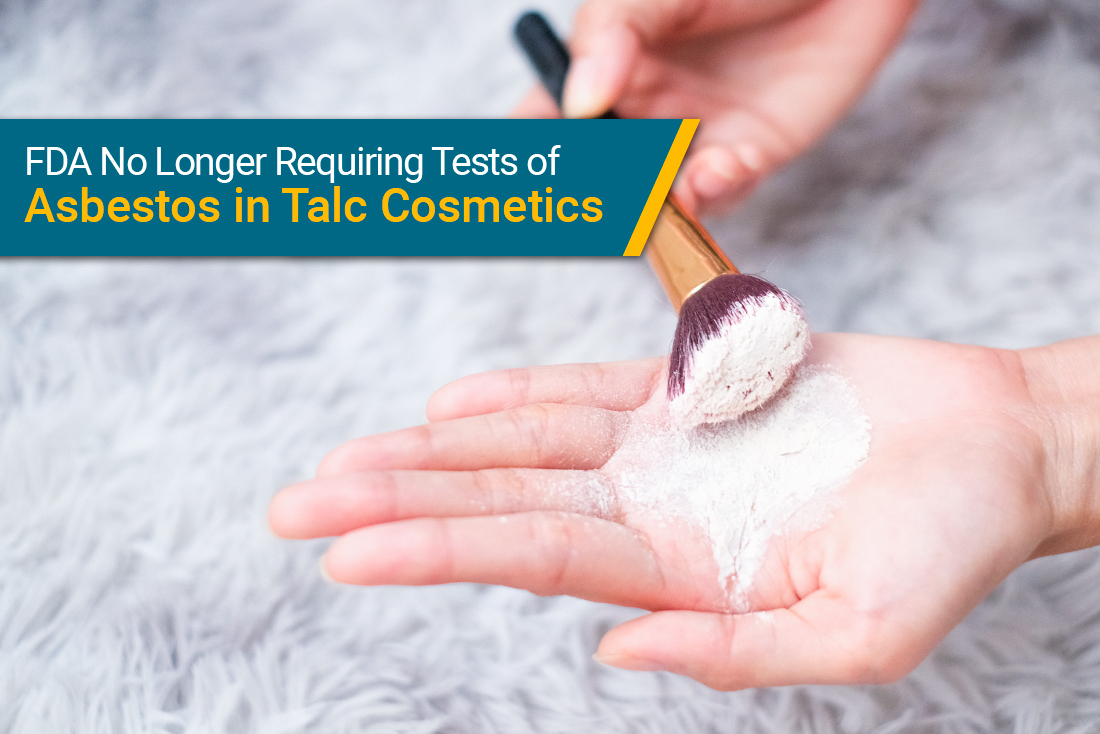
The FDA has withdrawn a proposed rule requiring the testing of talc for traces of asbestos. The New York Times, among other media outlets, reported the news last week.
The rule would have required manufacturers to test talcum powder and cosmetics made with talc. Tests a few years ago uncovered trace amounts of asbestos in Johnson & Johnson Baby Powder. Other products have struggled with asbestos contamination.
Explaining Relationship Between Asbestos and Talc
Asbestos is a mineral, as is talc. They can be found in the same geographic areas, which is how asbestos contaminates talc during mining and manufacturing.
Talc absorbs moisture and creates a smooth feel for skin, which is why it was prominent in baby powders and other cleansing products for children. Talc can also be found in candy, flavored chewing gum, and tablet forms of medication.
Mesothelioma is linked to asbestos in talc, as is ovarian cancer. Many women who use cosmetics such as mascara or even baby powder develop cancer years later. Asbestos diseases like mesothelioma take 20-50 years to form.
Impact of FDA’s Ruling
While Johnson & Johnson Baby Power is no longer manufactured or sold – the company replaced it with a cornstarch baby powder – manufacturers of eye shadow, lipstick, and mascara continue to make their products with talc. There is currently no rule mandating testing of talc products for asbestos. The FDA was set to require testing. The change allows these companies to use talc without testing for asbestos, which is a blow to consumer health.
Advocates for asbestos awareness and regulation criticized the decision. Linda Reinstein, president and chief executive of the Asbestos Disease Awareness Organization, spoke to the New York Times about the news.
“This is another horrific rollback,” said Reinstein, whose husband died of mesothelioma. “It puts the onus on Americans to have to try to identify consumer products that might be contaminated, and the average person can’t do that because you can’t know without testing.”
The U.S. Environmental Protection Agency (EPA) banned chrysotile asbestos in 2024. The decision marked the end of a loophole-ridden few years in which asbestos was regulated but allowed use in certain exceptions, such as the chlor-alkali industry. The ban requires this industry and others a few years of transition before moving past using asbestos.
The talc industry is different in that use of asbestos is never intentional. However, the inadvertent contamination of asbestos has been reportedly known by companies for years – with no substantial effort to protect consumers.
Now that asbestos testing is no longer required, this unintentional contamination can continue. In Europe, the European Union plans to ban talc from all cosmetics by 2027. The U.S. still seems a long way from such a rule.
Sources & Author
- F.D.A. Withdraws Rule to Require Testing of Cosmetics Made With Talc for Asbestos. New York Times. Retrieved from: https://www.nytimes.com/2025/11/26/health/fda-cosmetics-talc-asbestos.html, Accessed: 12/02/2025.