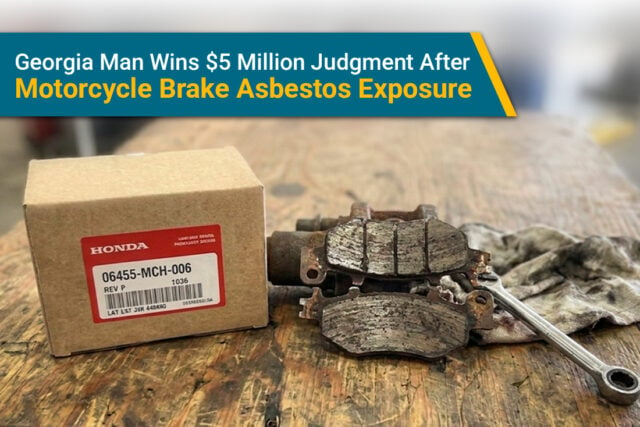
A Georgia man won a $5 million jury verdict in a lawsuit against the motorcycle manufacturers Honda and Yamaha earlier this month, after he was diagnosed with peritoneal mesothelioma following asbestos exposure from changing motorcycle brakes.
Donald G. “Greg” Lassiter was diagnosed with mesothelioma in 2019 at the age of 58, having spent much of his teenage years as an avid motocross racer who spent much of his free time riding, maintaining, and repairing motorcycles.
After a seven-year legal battle, a jury in the State Court of DeKalb County, Georgia returned a unanimous verdict in favor of Lassiter, placing 100 percent of the liability for his asbestos exposure on Honda and Yamaha.
More on Greg Lassiter’s Mesothelioma Victory
Lassiter spent over a decade, from approximately 1973 to 1984, regularly changing motorcycle brakes on various motorcycles he maintained as an avid hobbyist. Over 30 years later, he was diagnosed with peritoneal mesothelioma, a form of the deadly cancer that develops in the lining of the patient’s abdomen called the peritoneum.
Lassiter’s exposure to chrysotile asbestos through a non-occupational pattern presented some legal challenges as his lawsuit proceeded, as it was atypical from the occupational cases more commonly seen. Both based in Japan, Honda and Yamaha have long been among the largest manufacturers of motorcycles and motorcycle parts in the world.
Attorneys helped reconstruct Lassiter’s exposure by obtaining the same model Yamaha motorcycle that he had worked on during the time of his exposure, as well as contemporary Yamaha and Honda brake components identical to the ones that he may have used.
Lassiter, who has long outlived the average prognosis for peritoneal mesothelioma, testified at the trial himself. These efforts were enough to sway the jury to deliver him a large verdict in his favor.
Asbestos Risk in Motorcycle Brakes
Lassiter is just one of a number of people that were exposed to asbestos located in brake linings in cars and motorcycles. Brake linings were commonly made using chrysotile asbestos from the 1940s up until the early 1980s.
Mechanics were most at risk of receiving asbestos exposure during the course of their jobs, as asbestos dust could build up on brakes or clutches and become dangerous in the course of regular maintenance. Although asbestos began being phased out in the manufacturing of brake linings in the early 1980s, risk persisted through the 1990s and 2000s as mechanics worked on older vehicles. However, Lassiter’s story indicates that even hobbyists were at risk of exposure.
If you believe your mesothelioma diagnosis was a result of exposure via brake linings, there is compensation available to help with treatment. Asbestos trust funds have billions of dollars to help compensate mesothelioma patients and are just one form of support.
We can explain further about mesothelioma compensation for victims of occupational asbestos exposure.
Sources & Author
- After Seven-Year Fight, Simmons Hanly Conroy Secures $5M Verdict Against Honda and Yamaha. Illinois State Bar Association. Retrieved from https://www.isba.org/barnews/2026/10/aftersevenyearfightsimmonshanlyconroysecures5mverd. Accessed on 10/16/2026.