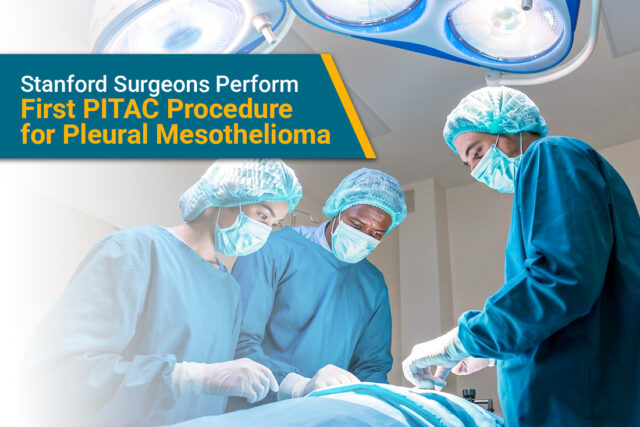
Surgeons from the Department of Cardiothoracic Surgery at Stanford Medicine made history by performing the first PITAC, or pressurized intrathoracic aerosol chemotherapy, procedures on patients with the rare cancer mesothelioma. The first such procedure was undertaken in March, with the second taking place in May.
The pioneering procedures were performed by Drs. Leah Backhus and Byrne Lee from Stanford Medicine, who hope that PITAC can provide a new option for mesothelioma patients who are not eligible for more invasive surgeries.
What Is a PITAC Procedure for Mesothelioma?
Dr. Backhus described the PITAC procedure as “spray paint chemo” – it is a video-assisted thoracic surgery that uses two small ports to gain access to the chest cavity. Doctors will then deliver a pressurized chemotherapy mist directly into the lining of the patient’s lungs, while employing a small video camera inserted between the ribs to observe progress.
This novel approach allows a high concentration of chemotherapy to be delivered to an isolated area of the body, while reducing exposure to areas unaffected by the cancer. Its minimally invasive nature made it an ideal fit for the two patients to receive its first use for mesothelioma, a cancer linked to exposure to the mineral asbestos.
The first patient had previously suffered from mesothelioma and had experienced a buildup of fluid in her lungs. She was able to return home two days after the procedure, and according to Dr. Backhus, showed no evidence of disease in her most recent scans.
“It looks like it is treating the tumor and not just treating the fluid,” Dr. Backhus said.
How Does PITAC Compare to Other Mesothelioma Procedures?
A similar procedure known as PIPAC – pressured intraperitoneal aerosol chemotherapy – has been successfully used in the treatment of peritoneal mesothelioma, found in the lining of the abdominal lining. Pleural mesothelioma – the most common form of the disease, which is found in the lining of the lungs – mirrors peritoneal mesothelioma, leading to optimism that PITAC will be a valid option for pleural mesothelioma patients moving forward.
The developers of the procedure have envisioned PITAC as sort of a “middle road” procedure. Pleural mesothelioma is often very difficult to remove surgically, and many patients do not fit the strict criteria required to receive more invasive procedures. In these cases, patients could receive PITAC instead, which could prolong their lives.
“PITAC is between these two extremes. It treats the tumor, but not radically so, and it also provides palliation for symptoms,” Dr. Backhus said. “It’s less risky for patients, and we can offer it to more people.”
How Could the PITAC Procedure Change Mesothelioma Treatment?
The promising early results from the first PITAC procedure have offered optimism for a new treatment option for patients with pleural mesothelioma, which is undoubtedly good news for patients everywhere.
Dr. Backhus and her team hope that they have developed a treatment that can offer similar results to more established surgical procedures with less invasion and a shorter recovery time, and further observation will continue in the coming years.
Pleural mesothelioma patients who are eligible for the PITAC procedure may be able to receive it through a registry study at the Stanford Medicine’s Thoracic Surgery Clinic.
Sources & Author
- Stanford Performs First PITAC Procedure for Mesothelioma in North America. Stanford Medicine. Retrieved from: https://med.stanford.edu/ctsurgery/about-the-department/news/2026/stanford-performs-first-pitac-procedure-for-mesothelioma-in-north-america.html. Accessed: 06/22/2026.